Digital tools were supposed to make marketing easier. AI promised scale, speed, and simplicity. But, many teams are asking a harder question: If we have more automation than ever, why does everything feel more chaotic?
The contradiction is clear across sales, SEO, content, and growth. Tools keep expanding, but clarity keeps shrinking. Brands are flooded with outputs, yet short on direction. The more software they add, the more strategic pressure falls back on people.
AI can generate headlines, schedule outreach, and analyze competitors. But it can’t decide what matters most to your brand, your market, or your next move. That gap between automated output and meaningful direction is where strategy breaks or wins.
What follows isn’t an argument against AI. It’s a realignment. The companies seeing real returns from automation aren’t chasing more tools. They are applying fewer tools with sharper intent.
The paradox of AI-driven automation in marketing
AI-driven marketing tools are everywhere. Content engines write blog posts in seconds. Outbound sales software automates outreach at scale. SEO platforms promise instant insights. In theory, this should make marketing effortless. In reality, most teams feel stretched thin.
In 2024 alone, global spending on marketing automation surpassed $8 billion, projected to increase by over 160 percent by 2032, reaching 21.7 billion dollars. (Statista). Despite this growth, Gartner estimates that just 33% of marketing stacks are fully utilized, signaling that most tool investments are underleveraged
Meanwhile, The CMO Survey Fall 2024 reveals marketers are using AI more — up to 11.1% of marketing activity overall, including 16.7% among B2B services. Those investments yielded measurable gains: 6.6% higher sales productivity, 6.3% more customer satisfaction, and 8.9% lower overhead. Marketers also reported burning fewer cognitive cycles on routine work, rising from a 2.4 to a 3.0 rating on strategic effort scale.

The numbers highlight a clear contradiction. Adoption is rising. Clarity is not.
Although it is commonly known that artificial intelligence has the potential to alter company operations and increase profitability, many organizations find themselves stuck in what we refer to as the “AI paradox.” This paradox refers to the gap that exists between understanding the promise of AI and successfully deploying it in order to produce measurable financial gains. Source: DOI
What was expected
- More time for creative and strategic work
- Faster, more efficient campaigns
- Scalable personalization
What happened instead
- Fragmented data across platforms
- Shallow, repetitive outputs
- Confusion over which metrics actually matter
- Higher operating costs with marginal returns
Despite the fact that 87 percent of firms around the world have begun artificial intelligence projects, just fifteen percent of those companies have used AI capabilities at scale in order to generate profitability.
J. Bughin and B. McCarthy
The ROI from AI: Evidence from Global Firms, McKinsey Quarterly, vol. 4, pp. 1-15, 2024.
Tool overload is not just a resource issue. It creates decision fatigue, misalignment across teams, and content that blends into the noise. Automation without direction doesn’t multiply impact. It multiplies noise.
Many growth leaders argue: “We don’t need more dashboards. We need better questions. Most dashboards don’t help people decide.”
A 2024 Gartner analysis revealed that 56% of enterprises encounter difficulties in AI integration because of legacy system incompatibilities and data silos
K. Panetta, “Gartner top 10 strategic technology trends for 2024,” Gartner, 2024.
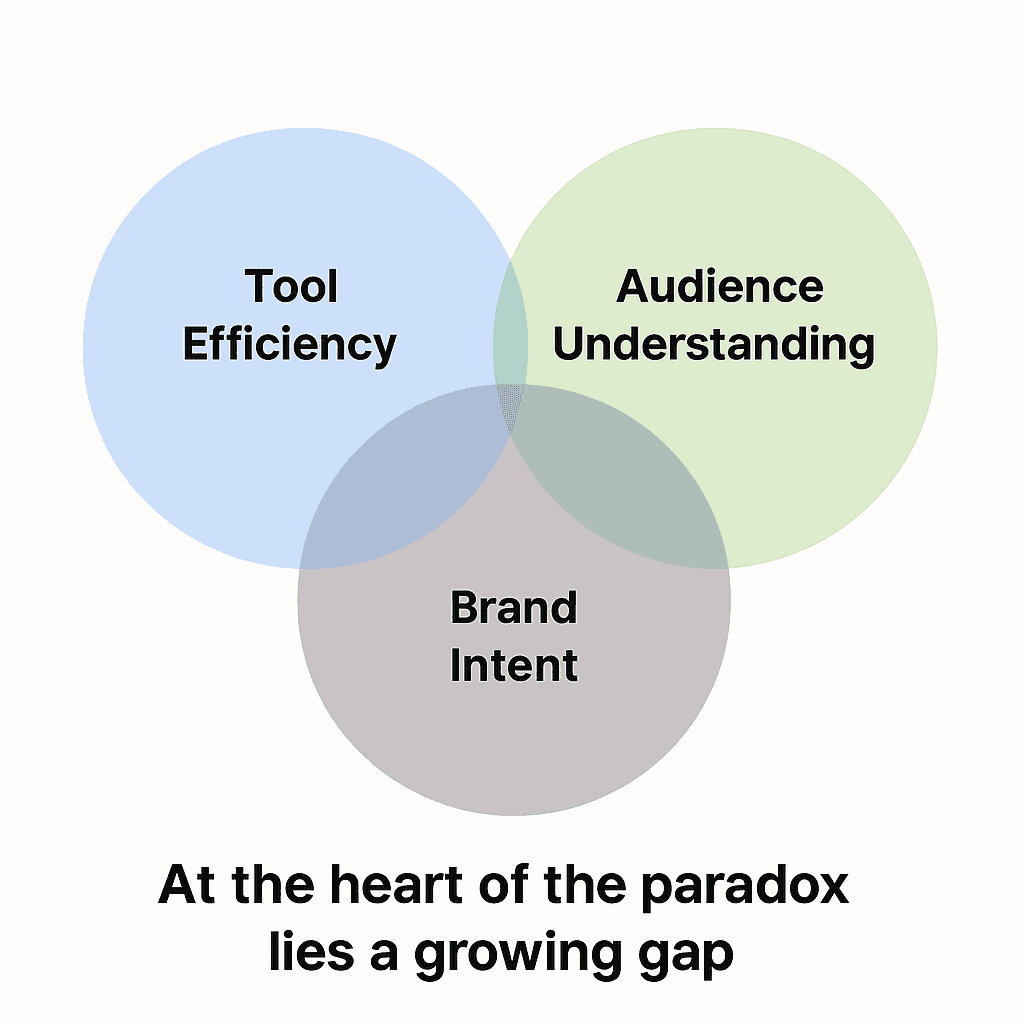
At the heart of the paradox lies a growing gap between tool adoption and message clarity. As teams chase efficiency through automation, the strategic coherence behind campaigns often lags behind. Features are implemented faster than narratives are shaped, creating a disconnect that slows conversion, muddles intent, and weakens brand traction.
For instance, teams lean on outbound sales software to scale outreach, but conversions stay low without a strong point of view or differentiated messaging. Others adopt SEO management tools hoping for fast visibility, only to discover rankings stall without aligned intent and structured content.
Why digital tools without human intent fall short
AI can generate content, trigger workflows, and score leads. But what it can’t do is know your buyer. Tools follow patterns. Strategy defines relevance. The gap between automation and intent isn’t just theoretical, it’s where most marketing campaigns lose momentum.
Take AI-generated blogs, for example. They’re fluent. They’re fast. But they’re also shallow, repetitive, and misaligned. Without human oversight, most of this content misses the real signals buyers are looking for clarity, insight, and originality.
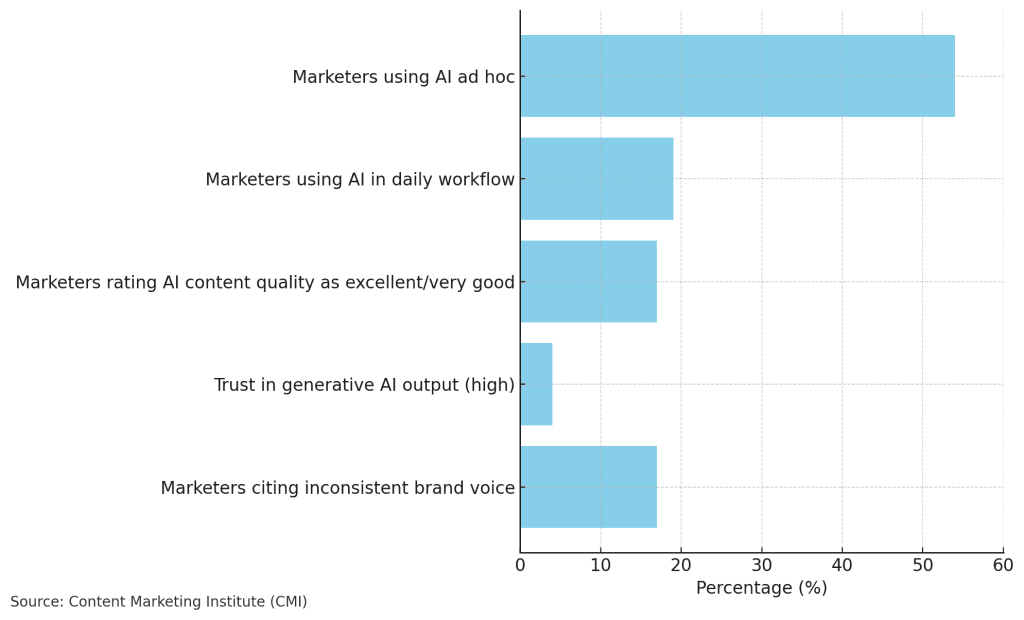
AI is everywhere, but strategic use is rare. Only 17% of marketers rate AI content as excellent, and just 4% highly trust it. With 54% using AI ad hoc and 17% citing brand voice inconsistency, it is misalignment, not the technology, that is holding results back.
Automation isn’t the enemy. Misapplication is.
Automation ≠ strategy
What digital tools offer is efficiency. What they lack is judgment. Here’s where things break:
- Topical coverage becomes keyword stuffing
- Content velocity outruns quality
- Templates override audience nuance
- AI-generated personalization feels canned without human segmentation logic
You can use an AI tool to produce ten landing pages in a day. But if none of them speak to your ICP’s pain, positioning, or buying stage, what you’re doing is scaling irrelevance.
Why intent is the differentiator
Intent is not about matching search volume. It’s about understanding why your buyer is searching, clicking, or hesitating.
- In SEO, this means designing seo pillar pages that group content by journey, not just keywords.
- In outreach, it means pairing outbound sales automation software with copy that reflects market timing and segmentation.
- In content, it means knowing which content marketing strategy builds trust vs. which simply fills space.
Without that strategic filter, tools execute noise at scale.
Conversion optimization is not just switching layouts or button colors. The real lift comes when you understand what your buyers feel and need—and connect with that intention.”
Talia Wolf, in Emotional Targeting discussion on Agents of Change Podcast
Tools like outbound sales software can handle the scale, but conversion relies on the segmentation logic and messaging crafted behind the scenes. Publishing seo pillar pages with templated copy may boost indexation, but without depth or journey alignment, they rarely rank or convert. And while AI can replicate common examples of content marketing, high-performing brands break through by anchoring content in real human insight — timing, voice, and nuance the tools can’t replicate on their own.
The illusion of productivity and what it costs
Modern tech stacks are stacked too high. On paper, everything looks efficient, content generated in seconds, competitor insights in dashboards, and campaign reporting updated in real-time. But in practice, teams are stuck managing the tools instead of driving results.
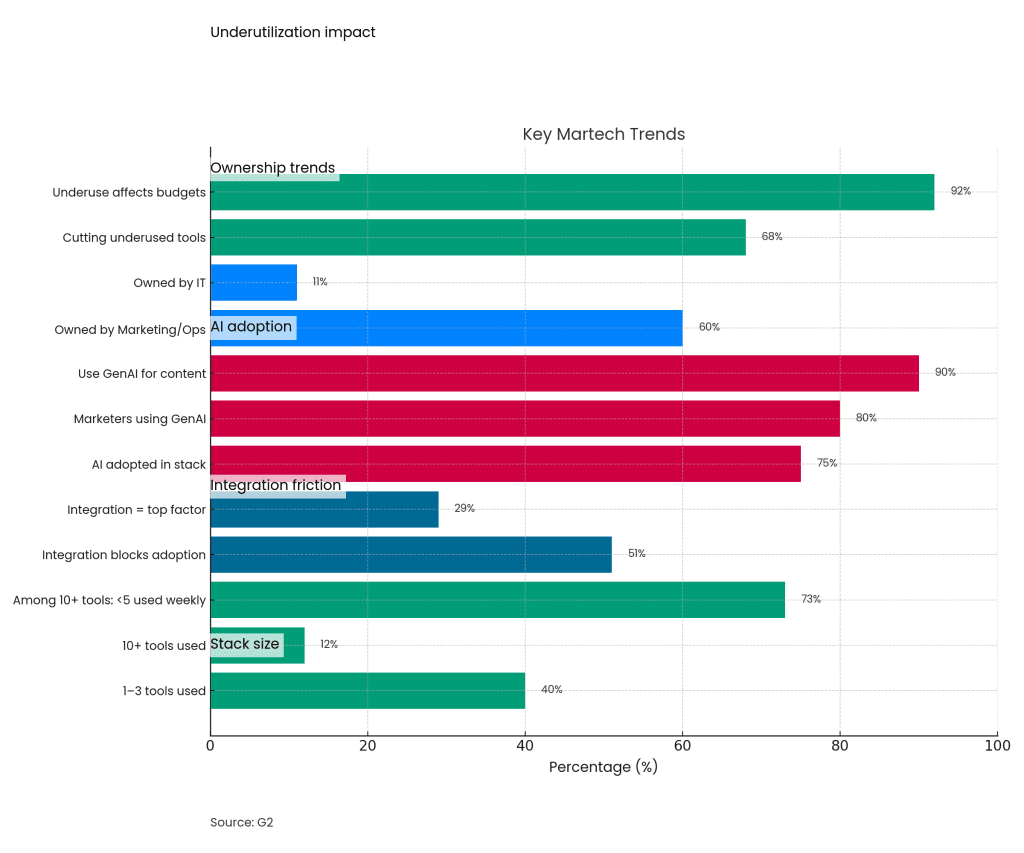
Only 12% of companies operate with 10 or more marketing tools, and even among those, 73% use five or fewer tools weekly (G2, 2024). The perception of large stacks often masks the real issue: tool overreach without alignment. Despite wide adoption, 68% of marketers say underutilized tools will be cut, and 92% of enterprise teams admit underuse threatens future budgets.
The appearance of productivity — busy dashboards, continuous optimization, auto-generated output masks the real issue: tool orchestration is eating time that should be spent on thinking.
The operational cost of “more tools”
Tool overload creates a hidden tax:
- Context-switching increases cognitive load and reduces focus
- Automated reports often drown signal in noise
- Setup and integration time steals energy from experimentation
- Perceived productivity blocks real outcome evaluation
Automation doesn’t save time if teams spend it debugging workflows or aligning Slack alerts to human goals. Likewise, producing content quickly means little if no one examines what it’s driving or why.
“We spend more time chasing clicks and measuring interactions than actually influencing decisions. That has to change.”
— Rand Fishkin, co-founder of SparkToro (source)
Many marketing teams confuse motion with direction. Activity feels productive, but without reflection, it becomes reactive.
Tool-driven marketing creates false signals
Automation can validate the wrong behaviors. A spike in AI-driven traffic may seem like success. But if it doesn’t move qualified leads or cannibalizes existing assets, it’s not progress.
This is where strategy begins to erode:
- Competitor analysis tools can encourage mimicry over differentiation
- Vanity metrics distract from buyer progression
- Task completion is measured instead of outcome achievement
- Search engine visibility is mistaken for meaningful market relevance
The existence of a metric doesn’t confirm its value. Without human judgment and review, automation tends to optimize what’s easiest to measure — not what matters.
Overreliance on competitor research tools can push brands into imitation. Similarly, chasing organic reach without clarity of who it’s reaching leads to inflated traffic and stagnant conversions.
Strategic clarity is the new system design
High-performing teams aren’t succeeding because they automate faster. They succeed because they know exactly what to automate.
Strategic clarity is no longer a differentiator, it’s infrastructure. It shapes how tools are selected, how workflows are built, and how performance is evaluated. Without it, velocity multiplies misalignment.
According to McKinsey, even high-performing companies can lose up to 30 percent of potential impact due to poor operating model execution. Clarity in structure and accountability often makes the difference between activity and results—even when toolkits and budgets are comparable.
Clarity isn’t a strategy. It’s the system that makes strategy executable.
When used as a system, clarity guides:
- Tool acquisition based on journey gaps, not feature checklists
- Content decisions based on buyer stage, not keyword density
- Messaging shaped around a singular value narrative, not market noise
- Channel prioritization based on real attribution, not trend cycles
This is how growth teams reduce friction: not by removing software, but by making every tool answer to a unified plan.
The clarity-aligned operations grid
| System Layer | Question to Ask | Tool Role |
| Buyer Narrative | What beliefs are we shifting? | Messaging and storytelling tools |
| Journey Mapping | Where does conversion drop? | CRM, intent data systems |
| Execution Gatekeeping | What will we not publish? | CMS, scheduling, QA layers |
| Feedback Interpretation | What insight changed the plan? | Analytics and experimentation layers |
This isn’t strategy on top of tools. This is tools answering to strategic layers and that distinction is what keeps momentum from turning into chaos.
Forrester’s Marketing Survey shows that 64% of B2B marketing leaders do not trust their own measurement systems for decision-making. That lack of confidence undercuts even the most advanced dashboards or automated reports, revealing a truth: without trusted metrics, clarity and alignment become impossible.
Without a unified narrative, structured topic hubs may check all the technical boxes but still fail to connect with decision-stage buyers. Many teams deploy automated outreach platforms to increase reach, yet rarely connect those outbound messages to the friction points that actually stall conversions. Even widely used content playbooks, when applied without contextual filtering, lead to misaligned messaging that blends into the noise rather than shaping intent.
Strategic clarity isn’t a soft skill. It’s the foundation that determines how effectively a team moves, scales, and outpaces noise. Without it, the smartest stack becomes a distraction.
Buyer behavior proves the need for human connection
The signal is consistent. People don’t need more content—they need resonance. What persuades today isn’t scale or personalization. It’s relevance, timing, and empathy aligned with their actual context. No automation stack can manufacture that. It takes human interpretation.
According to Forrester’s State of Business Buying, nearly 95% of B2B buyers expect generative AI to support their purchasing decisions in the near future, and buying committees typically involve 13 decision-makers across departments. That level of complexity demands contextual relevance — something most vendors still fail to deliver.
Elsewhere, Rand Fishkin of SparkToro argues that if content isn’t better than AI output, it’s effectively invisible, echoing why misaligned vendor messaging now loses engagement and trust quickly.
The result? A growing mismatch. As templated messaging and generic automation flood the market, attention spans shorten. Buyers aren’t just consuming, they’re filtering.
Buyers aren’t just scanning, they’re qualifying
At every stage, buyers are making rapid micro-decisions. The real question isn’t “Is this helpful?” It’s:
- Does this signal that the brand understands my challenge?
- Was this written for me or for a KPI dashboard?
- Does this offer feel timely, or just reactive?
Automation can’t answer these. Humans can.
Strategic empathy converts better than automation
This is where modern marketing separates signal from noise. High-performing teams don’t just scale outreach — they engineer relevance:
- They use intent data to listen, not just target
- They align content to emotion, not just search terms
- They write for actual roles, not fictional personas
- They build journeys that respect timing, not just delivery windows
These aren’t soft tactics. These are conversion mechanics.
When teams rely only on automation frameworks, they miss the subtle cues buyers expect — tone, timing, trust. Even SEO-optimized pages fall flat if they read like templates. Outreach that scales generically rarely lands when intent is off.
In a market saturated by tools, the human layer has become the new competitive moat. Connection over coverage earns attention. And attention earns conversion.
Simplifying your stack is a strategic decision, not a budget move
Tech stacks weren’t built to be bloated. They became bloated because priorities got reactive. When every new tool enters the system to solve an isolated pain point, complexity compounds silently.
Stack simplification isn’t about saving money. It’s about reclaiming operational control. Every additional platform adds cognitive friction — more metrics, more interfaces, more decisions. Over time, that overhead replaces momentum with maintenance.
When fewer tools produce more alignment
High-functioning teams don’t cut tools for minimalism, they refine their systems around purpose. They:
- Define outcomes before evaluating solutions
- Consolidate overlapping systems that create workflow drag
- Align reporting with decision points, not dashboards
- Remove tools that generate busywork but lack strategic value
This is not about scaling down. It’s about designing for intentional outcomes.
What simplification actually looks like
A growth-stage company may replace multiple point solutions with a consolidated seo management platform built around structured publishing. A lean product-led team might choose low cost domain registration to quickly launch segmented microsites without dependency on a heavyweight CMS. A content-led org could sunset underused platforms in favor of a single hub aligned with how their buyers discover, evaluate, and act.
Rationalization isn’t about cost anymore. It’s a filter for clarity.
“Momentum falters when teams chase features instead of decisions. Strategy, not stack count, defines impact.”
Instead of reacting to surface-level gaps, mature teams align their tools with real outcomes. Whether it’s rethinking search platform sprawl or investing in affordable digital infrastructure, they shift from reacting to refining.
Strategic depth doesn’t require more complexity. It requires disciplined constraint. When every part of the stack supports a mapped outcome, execution becomes frictionless and decisions get faster.
Questions every modern team should ask before adding another tool
Every tool comes with a cost — sometimes in money, often in attention. What looks like a time-saver during onboarding can quietly become a time sink over time. That’s why the most disciplined teams treat every tool addition as a strategic decision, not a tactical reflex.
Yet this rigor is rare. According to the G2 survey, 51% of marketers said integration challenges alone prevented them from adopting new tools, while 29% said integration was the top factor when evaluating a platform. That reveals a deeper issue, many tools are deployed before the real business need is clearly defined. The result: disconnected systems, redundant features, and workflows that look productive but stall momentum.
The most resilient organizations use a different approach. They ask better questions before they onboard.
The pre-adoption clarity filter
Before approving a new platform, high-functioning teams ask:
- What strategic outcome does this support?
If it doesn’t map to a clear growth lever—conversion, retention, velocity — it’s noise. - Is the problem technical or directional?
Many bottlenecks are caused by unclear messaging or misaligned strategy — not by missing tools. - Who will own this and how will success be measured?
Without an owner and a metric tied to a business objective, tools become abandoned shelfware. - Does this improve a decision or just report one?
Tools that track without driving better actions often mislead more than they help. - Are we clear on what we will stop doing if we use this?
Adoption is not additive. It must displace something less effective.
These questions aren’t checkboxes. They’re friction points that prevent misalignment before it spreads.
When tools don’t pass the filter
Ignoring these questions leads to:
- Overlapping tools fighting for attention
- Channels misfiring because they aren’t strategically sequenced
- Messaging diluted across disconnected execution
- Time lost interpreting dashboards that don’t lead to change
Tools that don’t support the brand’s core motion should be paused, parked, or purged.
Channel attention ≠ tool necessity
Take social media as a case. Many brands adopt new scheduling platforms because they believe they’re capturing attention on social media. But reach is not resonance. A new dashboard won’t change the fact that audiences scroll past messages that feel generic, out-of-place, or misaligned with context.
Before investing in another layer of automation, ask whether your current content is being ignored because of delivery — or because of disconnect.
Marketing teams often equate more posts with more traction, investing in social content automation without refining the brand’s message. But volume rarely translates to connection—especially on platforms where users scroll fast and filter faster. Before adding another tool, ask whether your voice is distinct or just loud.
The next tool will not fix a strategic gap. If there’s no clarity behind the decision, the best-case scenario is temporary lift. Worst case? More noise, more cost, and less trust.
Human thinking is the last real advantage in tool-saturated markets
Generative tools can repurpose faster, scale wider, and analyze deeper. But they still cannot question the brief, interpret intent, or redirect a campaign before it burns through budget. That kind of judgment is not built into the system. It comes from people.
The brands moving ahead are not just using advanced platforms. They are making deliberate choices to pause automation when alignment feels off, rethink performance metrics beyond clicks, and have uncomfortable discussions about what needs to stop rather than what to start.
Human-first strategy is not about resisting progress. It is about operational precision. As tool stacks grow more identical, the real differentiator becomes the thinking behind the configuration. What you choose to leave untouched by automation defines your edge more than what you deploy.
Many competitors rely on AI content repurposing platforms to stay visible. Few ask whether that content answers what buyers are actually searching for.
Strong strategy today favors clarity over motion.
The most advanced strategy is asking smarter questions
Every tool promises acceleration. But without the right questions, speed only takes you further in the wrong direction.
The marketers leading the shift are not just upgrading platforms. They are refining prompts, reframing briefs, and rethinking what performance actually looks like. AI adoption is not a shortcut. It is a pressure test for clarity, focus, and judgment.
Instead of asking “What more can we automate?” the sharper question is “Where should we pause and think?” That’s the real differentiator in a market flooded with identical tech stacks.
Smarter inputs. Sharper intent. Braver decisions. That’s where strategy starts to matter again.
The future won’t be won by teams that automate the most. It will be won by those who question the smartest, pause the longest, and choose the fewest moves with the most intent.