Startup SEO is structured demand capture. It builds visibility around high-intent queries that influence evaluation and reduce dependency on paid acquisition. As startups face tighter funding and shorter runways, paid CAC continues to rise while attribution weakens. SEO offers a compounding system where each indexed asset drives qualified discovery without recurring cost. For early-stage teams, this isn’t a traffic lever. It’s foundational to pipeline efficiency.
SEO for startups is not a scaled-down version of enterprise playbooks. There’s no brand-led search volume, no domain age advantage, and no room for unqualified reach. Execution must target buyer queries that reflect solution intent category comparisons, integration terms, and feature-level searches.
CAC data makes this a priority. In 2025, SaaS startups report average CAC near $700, with longer payback periods and lower ad ROI in competitive verticals. Organic search traffic remains the only acquisition channel where cost per conversion trends down over time if visibility is built around product-value alignment.
Startup SEO isn’t about publishing volume. It’s about constructing relevance signals: technical readiness, intent-mapped content, and credibility that can be earned before scale. Search is where trust forms.
Done right, SEO becomes the lowest-cost, highest-leverage acquisition layer available to growth-stage teams.
Why Startup SEO is Structurally Different from Enterprise SEO
Startups don’t inherit authority, they must build credibility through search. Enterprise domains often benefit from brand queries, legacy backlinks, and on-site content depth. Startups don’t have that luxury.
Most new content fails to surface. An Ahrefs study confirms that 96.55% of pages get zero organic traffic from Google. Among pages that do eventually rank in the top 10, only 1.74% achieve it within their first year. Of those, 40.82% reach that position within the first month, but this reflects a subset with optimized technical setups and well-aligned search intent, not domain age or brand lift. For startups, publishing without strategic intent means buried assets and wasted development effort.
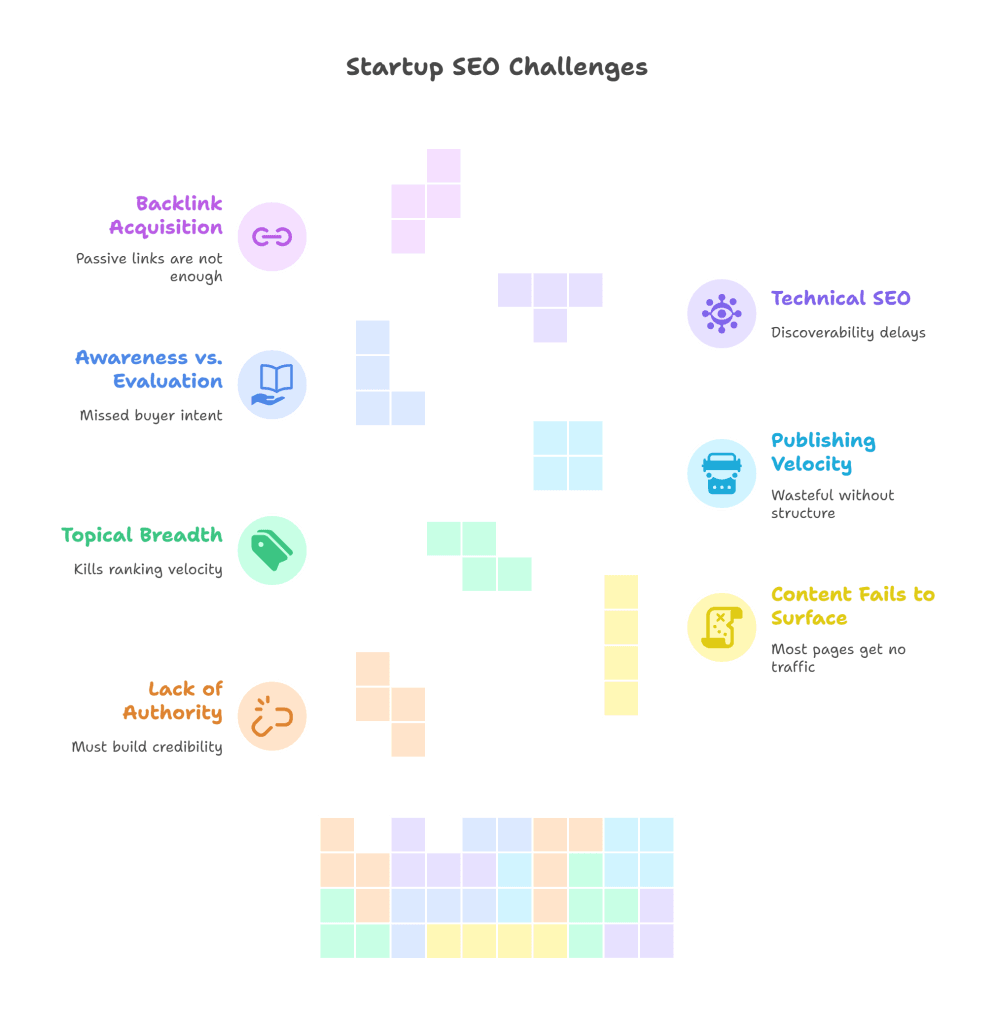
What this means for startup businesses
- Topical breadth kills ranking velocity. Unlike mature domains that can afford wide coverage, startups must cluster content around a single, tightly scoped problem space. Relevance density beats surface-level reach especially in early stages of product-market fit.
- Publishing velocity without structure is wasteful. Founders often assume SEO for a startup business means producing volume. But on low-authority domains, even 50 articles can fail if internal linking, schema configuration, and sitemap structure aren’t technically sound.
- Every page must serve buyer evaluation, not just awareness. The goal is not to rank for curiosity-driven top-of-funnel terms, but for queries that validate product fit, feature comparisons, integration support, and pricing qualifiers that match where buyers are in their journey.
- Technical SEO is non-negotiable. Startups cannot afford discoverability delays. One broken canonical tag or misconfigured robots.txt can postpone acquisition by weeks. Structured data, crawl efficiency, and minimal index bloat are not optimizations, they’re prerequisites.
- Backlink acquisition must be signal-driven. While enterprises attract links passively, startup SEO requires earning them through technical content, documentation, niche references, or founder-authored commentary. This is where agility creates leverage.
- Smaller teams pivot faster and that’s an advantage. Where enterprises spend quarters aligning SEO with cross-functional stakeholders, startups can ship relevance-driven updates immediately. That speed of correction is a structural advantage few exploit.
- Thought leadership matters more than volume. In many early-stage categories, founder-led content, technical breakdowns, transparent growth commentary, or teardown-style posts can rank and earn backlinks more reliably than generic SEO copy.
Startups cannot afford SEO debt. The cost of misaligned visibility isn’t just slow growth, it’s lost runway. When executed with intent, SEO for startups becomes a structured demand engine, aligning visibility with actual acquisition and buyer readiness.
Core startup SEO initiatives to prioritize
Search visibility for startups is not a function of how much content is produced. It is a reflection of three underlying systems: a technically stable delivery layer, content anchored to the way people evaluate options, and early signals of credibility from sources Google already trusts. These are not surface-level tactics. They are foundational mechanisms that decide whether a domain can compound organic traffic in the first place.
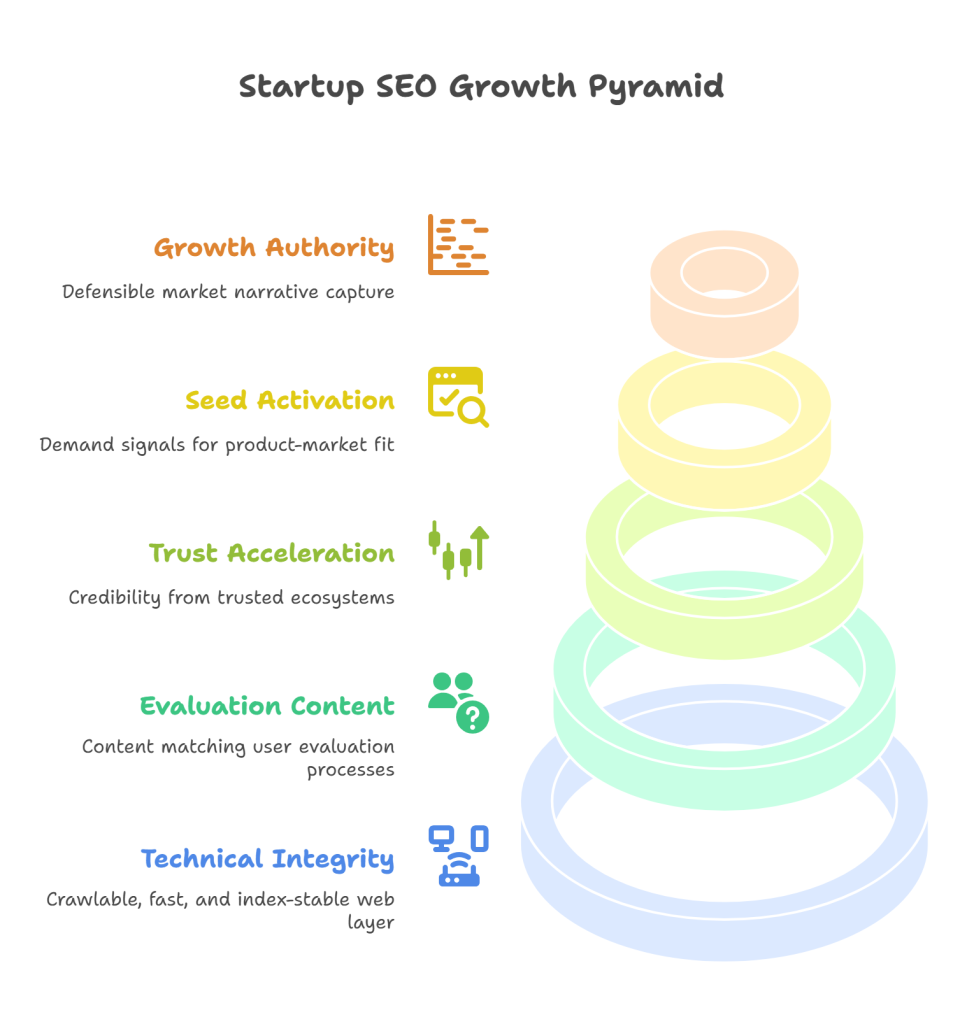
For both consumer and business startups, SEO must be sequenced based on readiness, not aspiration. The following initiatives form that sequence.
Technical integrity: Make the index layer navigable, interpretable, and fast
Search engines prioritize websites that are stable under load, consistent in structure, and efficient to parse. Startups often inherit the opposite. Launch-speed decisions lead to bloated templates, client-side rendering conflicts, and misaligned metadata. Fixing this is not optional.
Key technical priorities:
- Crawl accessibility – Limit Google’s discovery surface by restricting irrelevant folders in robots.txt. Use sitemap.xml to guide indexation and monitor coverage anomalies in Search Console.
- Canonical precision – Every URL must exist in one logical form. Resolve trailing slash mismatches, query parameter duplications, and uppercase variants. Enforce canonical rules in both the head tag and server response.
- HTTPS enforcement – Every startup domain must default to HTTPS with HSTS enabled. Mixed-content requests break trust signals and reduce the likelihood of secure indexing.
- Error handling – Serve clean 404 and 410 responses. Redirect chains or soft-404 pages dilute crawl efficiency and reduce link equity transfer.
- Core Web Vitals compliance – Google’s Core Web Vitals remain a critical ranking signal. Page Experience factors especially user-centric metrics like LCP under 2.5 s, INP under 200 ms, and CLS under 0.1 continue to influence SEO visibility and engagement.
No SEO initiative performs without infrastructure that is index-friendly, performant, and analytically traceable.
Evaluation-centered content: Map visibility to real decision points
Most startup websites prioritize awareness. Most startup users, however, search with evaluation in mind. They compare, validate, and seek configuration clarity before conversion. SEO content must reflect that sequence.
Build foundational clusters around:
- Comparative queries – Users search for product alternatives when actively exploring solutions. Phrases like best fitness app for Android or Notion vs Airtable for workflows indicate readiness to choose. These pages require specific, structured comparisons, not generic sales copy.
- Task-led formats – Use case pages outperform blogs when mapped to intent. Rather than explaining features, structure content around outcomes such as how to export CRM contacts to Excel or affordable weeknight vegan recipes. These convert curiosity into engagement.
- On-page semantic context – Internal links must support topic depth, not just navigation flow. Schema types like FAQPage, HowTo, and Product help clarify page purpose in search results, increasing both click-through rate and rank persistence.
Content that ranks must do more than educate. It must answer the exact question a user has before taking the next step in their journey.
Trust acceleration: Earn early credibility through context, not volume
New domains are not penalized, but they are under-observed. Google needs external signals to validate that a website is legitimate, current, and cited in its relevant ecosystem. Trust cannot be assumed. It must be earned.
Establish signal-based credibility by:
- Publishing high-context content assets – Long-form explainers, feature guides, or configuration tutorials tend to attract early organic links. These are more likely to be referenced in niche communities than landing pages or marketing blog posts.
- Activating existing ecosystems – Directories, launch platforms, and product listing forums often carry strong domain authority. Submitting to Product Hunt, BetaList, or even curated subreddits can result in faster indexation and passive referral links.
- Enabling content portability – Assets like changelogs, public roadmaps, and user setup guides are often cited in support docs, integration hubs, or open source wikis. These earn defensible backlinks without paid outreach or PR.
Avoid chasing links. Instead, ship pages that people solving similar problems want to bookmark, reference, or share.
Seed stage: Align content velocity with product-market fit
Once users begin testing the product, SEO must serve as a demand amplifier. This is where the foundation set in Section 2 transitions into strategy.
Core actions:
- Niche content clusters – Develop tightly scoped content around the product’s most defensible use cases. For a B2B API startup, this might be integration walkthroughs. For a consumer app, it could be lifestyle-specific guides tied to the core feature.
- Early comparison pages – Create decision-led assets that answer queries like “X vs Y” or “best tools for Z.” Research shows comparison queries account for 15–20% of high-intent searches in software and consumer products.
- Feedback-driven iteration – Use queries identified in Search Console impressions even if they rank on page 3–4, to adjust content positioning. These are signals of latent demand the market has already mapped to your brand.
The goal at seed is not breadth but evaluative depth. Every page must reduce friction between discovery and signup.
Growth stage: Expand authority and capture new demand horizons
As funding and traction increase, the SEO strategy must shift from survival to defensibility. Startups that fail here often stagnate because they continue publishing narrow clusters without evolving into authority-level visibility.
Core actions:
- Authority hubs – Build evergreen, reference-grade resources that capture the informational layer of your category. Long-format technical guides, industry glossaries, or definitive consumer how-to frameworks create durable traffic.
- International and multilingual SEO – For B2C startups scaling globally, implementing hreflang and localized content is critical. For B2B, regional landing pages aligned with compliance or market nuances improve lead qualification.
- Topical breadth without dilution – Once authority is established, expand clusters laterally into adjacent problems. A wellness app might branch into nutrition and sleep content, while a devtool might extend from logging into observability.
At the growth stage, SEO is no longer about ranking a few pages. It is about building category authority that compounds valuation.
Building a startup SEO strategy that compounds
Startup SEO cannot be treated as a flat checklist. It is an evolving framework that matures with funding stage, user base, and product-market fit. Unlike enterprises, startups do not scale visibility linearly. Instead, they compound it by sequencing the right tactics at the right stage. The roadmap below reflects how SEO must adapt across phases of growth.
Pre-launch: Create a discoverable foundation before scale
Before the product goes public, the SEO strategy for a startup must already establish a trust baseline. Early-stage SEO is less about volume and more about signaling legitimacy.
Core actions:
- Single-page visibility assets – Launch with a lean site that covers the essentials: product overview, team credibility, and a clear call to early waitlist or beta access.
- Schema-first setup – Apply Organization, FAQ, and Product schema to structure how search engines interpret your entity. Even without traffic, structured data accelerates trust.
- Brand query anchoring – Secure branded SERPs by optimizing for “[startup name] + reviews,” “[startup name] + pricing,” and “[startup name] + founder.” This prevents competitors from owning those early mentions.
The objective at this stage is index stability and brand control, not traffic volume.
Seed stage: Align content velocity with product-market fit
Once users begin testing the product, SEO must serve as a demand amplifier. This is where the foundation set in Section 2 transitions into strategy.
Core actions:
- Niche content clusters – Develop tightly scoped content around the product’s most defensible use cases. For a B2B API startup, this might be integration walkthroughs. For a consumer app, it could be lifestyle-specific guides tied to the core feature.
- Early comparison pages – Create decision-led assets that answer queries like “X vs Y” or “best tools for Z.” Research shows comparison queries account for 15–20% of high-intent searches in software and consumer products.
- Feedback-driven iteration – Use queries identified in Search Console impressions even if they rank on page 3–4, to adjust content positioning. These are signals of latent demand the market has already mapped to your brand.
The goal at seed is not breadth but evaluative depth. Every page must reduce friction between discovery and signup.
Growth stage: Expand authority and capture new demand horizons
As funding and traction increase, the SEO strategy must shift from survival to defensibility. Startups that fail here often stagnate because they continue publishing narrow clusters without evolving into authority-level visibility.
Core actions:
- Authority hubs – Build evergreen, reference-grade resources that capture the informational layer of your category. Long-format technical guides, industry glossaries, or definitive consumer how-to frameworks create durable traffic.
- International and multilingual SEO – For B2C startups scaling globally, implementing hreflang and localized content is critical. For B2B, regional landing pages aligned with compliance or market nuances improve lead qualification.
- Topical breadth without dilution – Once authority is established, expand clusters laterally into adjacent problems. A wellness app might branch into nutrition and sleep content, while a dev tool might extend from logging into observability.
At the growth stage, SEO is no longer about ranking a few pages. It is about building category authority that compounds valuation.
Startup SEO tips that actually move the needle
Most early SEO efforts underperform not due to lack of action, but due to misaligned execution. Whether you’re building a consumer brand or a technical product, these tactics address where startup SEO usually stalls: unclear intent signals, poor content structure, and shallow visibility scaffolding.
The following approaches apply across B2C and B2B startups whether you’re selling subscriptions, shipping software, or scaling community-driven marketplaces.
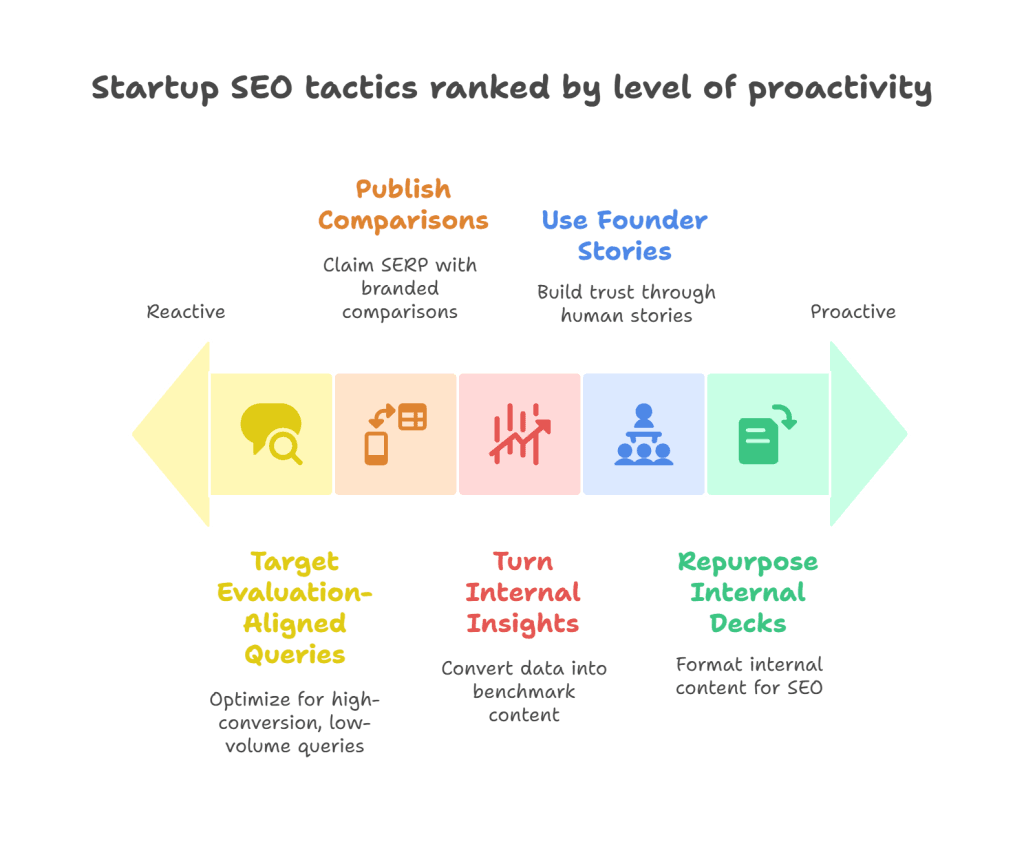
Target evaluation-aligned queries, not just broad demand
Search volume alone does not indicate readiness to act. Startups often publish content based on what’s trending, not what people actually compare or choose from. Instead, optimize for low-volume queries with higher conversion proximity.
Replace best fitness app with
- step counter that syncs with Garmin
- free pregnancy tracker without ads
- budgeting app for college students
These reflect task-led decisions, not passive interest. Query specificity increases CTR and keeps content in context, especially on new domains that lack brand recognition.
Publish comparisons before people search for them
If you’re launching a new meditation app, users won’t yet search for “[your app] vs Calm”. But Calm will rank for branded comparisons eventually—unless you claim that SERP first.
Startup SEO must be defensive before it becomes competitive. Build pages like:
- [App name] vs Headspace: Pricing, Sleep Features, and Audio Quality
- How [App] compares to [Category Leader] if you only meditate 5 minutes a day
Use semantic HTML and FAQPage schema. Format matters. Side-by-side breakdowns work better than narrative paragraphs, especially for mobile.
Turn internal insights into link-worthy artifacts
Consumer apps generate high-frequency user behavior. But most of that data lives in dashboards. Convert patterns into benchmark-style content:
- The 2025 average sleep score by age group (for a sleep tracker)
- What 1.2M grocery orders tell us about changing dietary habits (for a grocery delivery app)
- Weekly running trends by city (for a fitness startup)
These assets attract press, blogs, and community backlinks. After Google’s core update targeting scaled low-value content, original research now outperforms listicles or AI rewrites.
Use founder stories to bypass domain age constraints
For early consumer brands, the fastest way to build trust is through a human face. If your skincare startup doesn’t yet rank, your founder might. Publish content such as:
- Why I built a fragrance-free moisturizer after my child’s skin allergy
- How we tested 11 formulas before launch
- Behind the scenes of our first 500 orders
Then cross-publish these on:
- Your blog
- LinkedIn or Medium
- Product pages (as narrative blocks)
- About/Founder section
These stories add schema-recognizable authorship signals (via ProfilePage, Article, or Person) and reduce bounce rate from human engagement metrics Google does evaluate downstream.
Repurpose internal decks and memos into public knowledge
If you’re pitching investors or updating stakeholders, chances are you’re explaining your positioning and product decisions clearly already. That content has SEO value if properly formatted.
Examples:
- Why we removed the gamification badge from our journaling app
- How our DTC brand grew 3x without Instagram ads
- Design trade-offs in building our zero-sugar energy bar
Add internal headers, bullet structure, and interlinking. These “transparency narratives” build brand salience and show up in unbranded mid-intent queries, especially those looking for real founder journeys.
When to work with a startup SEO agency or consultant
Most startups misjudge SEO staffing decisions by reducing them to budget. The real question is whether internal resources can execute against systems design, technical diagnosis, and compounding content velocity. This decision must reflect operational bottlenecks, not tactical overwhelm.
The threshold is simple: if your internal team cannot maintain search performance across crawlability, content production, and off-page growth, something must be delegated.
Foundational assessment: is your constraint knowledge, time, or signal clarity?
Before assigning tasks, clarify what type of support you’re actually missing:
| Constraint | Indicators | Solution |
| Lack of SEO systems knowledge | Inconsistent indexing, no content architecture, broken sitemaps | → Startup SEO consultant (audit + roadmap) |
| Execution bandwidth | Too few articles published, broken canonical chains, no schema setup | → Startup SEO agency (ops augmentation) |
| Strategic uncertainty | No idea what topics to target, what format ranks, or how competitors win | → Consultant first, then agency for execution |
When to keep SEO in-house (DIY model)
Founders or product-oriented teams often take early ownership of SEO when surface-level traffic goals align with controlled experimentation. Keeping SEO in-house makes sense if:
- Domain is under 30/50 URLs
- Funnel queries are narrow and well understood
- Site health can be monitored internally
- Core content themes are few and tightly linked to the product
Internal execution is viable if:
- You’re pre- or post-MVP
- You’re collecting early feedback loops directly from users
- Budget for SEO is <5% of overall spend
Caveat: Early in-house execution often faces experience bottlenecks. When SEO is delegated to junior marketers without access to diagnostics, link ecosystems, or technical auditing capacity, the long-term cost of visibility debt outweighs short-term savings.
If your team lacks SEO-specialized capacity, fully managed startup SEO services may be more cost-effective than spreading ownership thin across generalists.
When to hire a startup SEO consultant
Consultants provide diagnostic precision and often short-circuit visibility stalls by identifying missed signals. Engage one when:
- Technical SEO is fragile and blocking indexing
- Traffic exists, but high bounce and low conversion persist
- Updates have reduced query alignment or SERP presence
- You’ve hit a visibility ceiling despite publishing velocity
- You need to assess ROI risk before further investment
Top-tier startup SEO consultants can also execute critical components, especially in link building, digital PR, citation-level signals, and SERP influence. Their network depth often replaces years of cold outreach or fragmented pitching by internal teams.
Precondition: Consultants should not be engaged unless:
- You’ve achieved product–market fit
- You can project ARR within 12–18 months
- You’ve allocated at least 10–12% of your overall budget to SEO and marketing initiatives
When a startup SEO agency becomes necessary
Agencies provide throughput scale. They don’t set vision, they operationalize it.
Suitable agency-stage signals:
- Site has >100 indexed pages
- You need 4+ articles/month with technical formatting and UX hooks
- Internal teams lack time or skill to implement audits
- Link acquisition is stalling, and editorial or affiliate placements are needed at volume
- You’re targeting international markets, new categories, or horizontal search expansion
Funding note: This can occur as early as seed stage—not only at Series A. If you’ve raised capital and structured for GTM velocity, SEO becomes core infrastructure. Allocating 10–12% of the annual spend toward owned visibility is not aggressive, it’s required for channel survivability as CACs rise across paid media. Just like consultants, agencies only deliver impact when paired with strategic clarity. If product messaging, persona targets, or activation metrics are unstable external execution compounds noise.
How to avoid common SEO mistakes for your startup business
Across early-stage startups, SEO performance loss rarely comes from lack of effort. It’s the mis prioritization of that effort e.g. publishing content before aligning indexation logic, targeting volume before resolving buyer queries, shipping pages that split rather than consolidate relevance.
| Mistake Category | Root Cause (Left Column) | Fix (Right Column) |
|---|---|---|
| Chasing volume over intent | Generic keywords, zero conversions | Map to buyer stage, use modifier segmentation |
| Indexation misalignment | Crawl waste, orphaned pages | Sitemap segmentation, contextual linking |
| Customer insight gap | Keyword tools > user questions | Reinject actual query language |
| Branded vs non-branded blind spot | No SERP isolation | GSC filters, track by intent-led asset clusters |
| Keyword cannibalization | Query overlap, CMS bloat | Audit → merge/redirect, differentiate by purpose |
| Cheap SEO traps | Fiverr links, vanity metrics | Evaluate provider by signal output, not package promises |
| Partner-hopping or early abandonment | Mistaking lag for failure | Commit to 6–9 months; track directional signal lift |
| AI obsession without clarity | Tool abundance > pipeline impact | Intent-first, tool-second approach with audits |
These aren’t beginner errors. They’re structural inefficiencies that persist into scale, compounding silent losses across rankings, clicks, and conversions.
Below are the most technically consequential startup SEO mistakes, and the operational fixes that reverse their impact.
Chasing volume over intent density
Founders often target keywords with the highest search volume under the false belief that traffic equals traction. In practice, this results in diluted content relevance and wasted crawl budget.
Problem:
- Targeting generic keywords like CRM software instead of best CRM for real estate agents
- Publishing content that ranks but never contributes to pipeline metrics
Fix:
- Build content trees around specific buyer goals, use cases, integrations, and decision criteria
- Segment your topic research into:
- Awareness modifiers → what is, how does
- Evaluation qualifiers → best X for Y, X vs Y, features that…
- Activation triggers → set up, migrate, pricing breakdown
Result: Higher CTR, lower bounce, stronger query match.
Ignoring crawl cost and index friction
Startups often launch content without understanding how Googlebot interprets site structure. This creates a crawl economy imbalance, where low-priority or orphaned pages dilute overall discoverability.
Unlinked or ‘orphan’ pages often go undiscovered by Google and squander crawl budgets, even if they contain high-value content. OnCrawl’s analysis shows how orphan pages dilute index efficiency and resource prioritization.
Fix:
- Submit XML sitemaps segmented by content type
- Use contextual internal linking, not just navigation menus
- Eliminate soft 404s, duplicate paginated content, and zombie pages (indexed but never visited)
Overusing tools while underusing customer feedback
Startups often rely on SEO tools to generate keyword ideas—but ignore what real users say during onboarding, churn calls, and feature requests.
Problem:
- Keyword clustering tools suggest “how to use product X”, but your users keep asking “does it work with Stripe”?
- You write blog posts, but skip “Help Center” or “Use Case” content that matches buyer searches
Fix:
- Extract actual query language from:
- Support tickets
- Sales call transcripts
- Canny/Intercom/Typeform logs
- Reinject those terms into H1s, subheadings, FAQs, and schema fields
Failing to separate branded and non-branded strategy
Many early teams measure organic growth without isolating branded search lift from true discoverability.
Symptoms:
- 80% of organic traffic is branded queries
- Ranking pages are dominated by homepage or careers page
- Blog posts generate impressions but few click-throughs
Fix:
- Use Google Search Console filters to separate branded vs non-branded queries
- Create a ranked asset table that maps:
- Query type
- Landing page
- SERP position
- Conversion path
Track progress by non-branded lift, not raw clicks.
Leaving cannibalization and duplication unaddressed
When multiple pages compete for the same query, Google splits visibility, and neither ranks well. Most early content teams accidentally create keyword cannibalization through overlapping titles, poor canonical handling, or uncontrolled CMS behavior.
Fix:
- Run regular audits for:
- Title/Meta duplication
- Query overlap between blog, landing, and docs
- Internal link dilution (multiple pages splitting anchor text for same keyword)
- Consolidate low-performing siblings using 301 redirects or canonical merges
- Adjust on-page copy to differentiate by query intent (feature-focused vs how-to vs comparison)
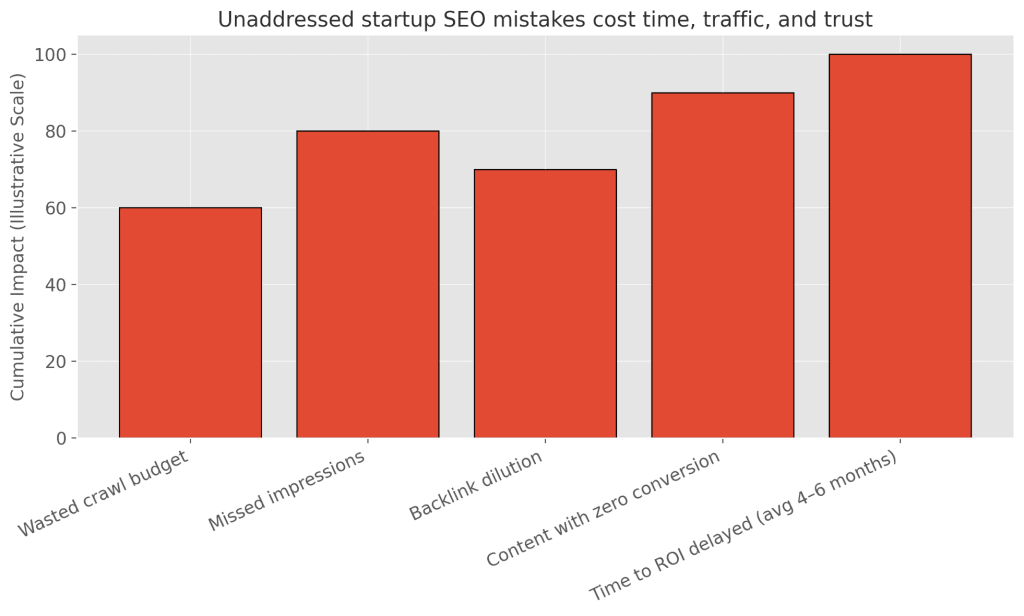
Falling for cost traps, link schemes, and metric mirages
Budget constraints often drive startup founders to opt for low-cost SEO solutions, freelancers, Fiverr gigs, or bulk-link packages marketed as short-term wins. But cheap SEO doesn’t save money. It creates cleanup debt that compounds silently.
Symptoms:
- Backlink profile filled with irrelevant, templated guest posts or sidebar placements
- Multiple domains pointing to the homepage with identical anchor text
- Vanity metrics like DA, DR, or backlink count used as performance benchmarks
Technical risk:
- Link velocity mismatches with domain age
- Unnatural link patterns trigger algorithmic suppression
- Schema spam, thin pages, and doorway strategies quietly accumulate penalties
Fix:
- Treat SEO as signal compounding, not tactic stacking
- Evaluate service providers on strategy maturity, not pricing tiers or deliverable volume
- Avoid any agency or consultant selling “link packages” without editorial or brand context
- Build credibility through high-trust mentions (docs, use cases, founder content, earned PR) rather than manufactured backlinks
Reminder: You don’t build links, you earn them through product utility, technical transparency, and problem-first content.
Abandoning SEO systems prematurely
Early-stage founders often treat SEO like performance marketing—expecting immediate causality between spend and results. When rankings don’t materialize within a few weeks or organic traffic plateaus, the instinct is to replace the consultant, fire the agency, or restart the strategy from scratch.
This behavior stems not from impatience, but from misunderstanding SEO’s time-to-signal curve.
Symptoms:
- Switching SEO providers every 3–4 months
- Iterating titles, content, and site structure too frequently
- Changing direction based on isolated GSC drops or keyword rank fluctuations
- Equating organic growth with campaign failure due to lack of short-term attribution
Technical consequence:
- Index stability erodes due to frequent page changes and re-submissions
- Link equity never compounds because of inconsistent anchor targets
- Query consistency breaks, confusing search engines about content authority
- Internal link structures are reset before relevance graphs stabilize
Fix:
- Map each SEO initiative to a decision layer: technical, content, or off-page
- Create a minimum viable time horizon (usually 6–9 months) before changing strategy or vendor
- Track directional improvements: impressions per cluster, crawl efficiency, average query position, not just traffic or conversions
- Diagnose execution issues before changing partners. Many strategies fail in implementation, not in design
Reality: SEO underperformance is often due to incomplete system execution, not partner quality. Swapping teams too early resets momentum and erodes trust signals already accrued.
Obsessing over AI tools without embedding strategic clarity
AI platforms promise rapid content generation, automated workflows, and instantaneous insights. Yet, growth teams often mistake tool abundance for impact. They produce volumes of AI-driven drafts, dashboards, and auto-scheduled outputs — only to find clarity is declining, not traffic.
Problem:
Startups fall into the trap of stacking AI tools for SEO (auto-generators, optimization dashboards, AI briefs) without aligning them to query intent, buyer context, or publishing frameworks. The result is content clutter, diagnostic noise, and zero pipeline lift.
Consequences:
- Semantic misalignment: AI-generated content may mimic keywords but lacks real buyer empathy.
- Dashboard paralysis: Velocity metrics obscure whether content is actually moving the needle.
- Execution drift: As teams chase new tool features, execution becomes reactive, not directional.
Fix:
- Limit AI usage to modules with clear decision logic. For SEO, tools serve:
- Keyword expansion (seed-level ideation, not full copy production)
- Schema generation (FAQ, HowTo nodes)
- Internal linking suggestions (calculated, not templated)
- Always pair AI output with intent validation:
- Does this answer an existing GSC query with significant volume or potential?
- Will it serve evaluation-state intent?
- Is it interlinked within your content architecture with click flow in mind?
- Regularly audit tool use. If an AI tool isn’t reducing effort or raising interaction, pause it. Strategic clarity must lead, automation must follow.
Measuring ROI of startup SEO vs paid channels
Early-stage companies often default to paid channels because feedback loops are fast, targeting is granular, and results are immediately visible. But speed and scale are not the same and over time, paid CAC increases linearly, while SEO acquisition cost flattens.
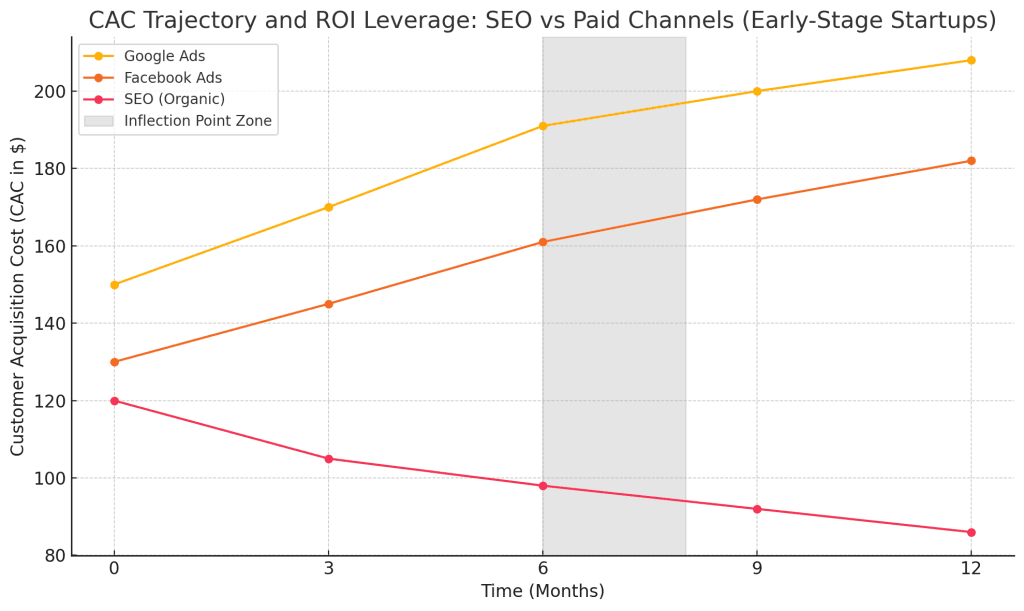
Understanding the ROI trajectory of SEO versus paid is not about traffic volume, but unit economics, scalability under budget constraints, and cross-channel compounding.
Customer acquisition cost: decay vs drift
| Channel | Avg. CAC after 6 months | CAC after 12 months |
| Google Ads | $191 | $208 |
| Facebook Ads | $161 | $182 |
| SEO (Organic) | $98 | $86 |
- Paid CAC increases over time due to rising cost-per-click (CPC), fatigue in ad creatives, and shrinking marginal returns.
- SEO CAC declines post-initial investment as indexed assets begin to rank, earn links, and reduce dependence on spend.
For early-stage companies with finite marketing capital, this divergence affects both scalability and survivability.
SEO growth strategy builds margin, not just traffic
The compounding nature of organic search isn’t just a philosophical advantage it’s a tactical operating moat.
Why SEO scales under fixed budget:
- Each published page can earn value independent of spend
- Link equity compounds across domains, unlike siloed ad campaigns
- Behavioral signals (click-through rate, dwell time) improve as UX and query match converge over time
Result:
You can increase pipeline contribution from SEO without increasing spend. In paid, every additional conversion requires an incremental budget.
This is why smart early-stage companies adopt a hybrid SEO growth strategy:
- Paid for tests, search lift, and immediate traction
- SEO for compounding, CAC reduction, and competitive insulation
Budget shift: what reallocation looks like in practice
According to McKinsey, high-growth companies are nearly three times more likely to reallocate marketing spend dynamically during the year than low-growth peers.
This isn’t random! It reflects an ability to observe which channels produce marginal return at scale.
In the context of early-stage marketing, startups that identify signal velocity in SEO (e.g., rising impressions per URL, query position lift, improving crawl frequency) begin shifting 10–30% of their paid media spend into SEO ops:
- Scalable content production
- Technical audits and optimization
- Link acquisition via digital PR or founder content
The goal isn’t to abandon paid, it’s to blend CAC-efficiency with defensibility.
McKinsey’s growth benchmarking also emphasizes the long-term advantage of organic over acquisition-based scale not just because it reduces CAC, but because it drives sustained valuation lift without recurring spend.
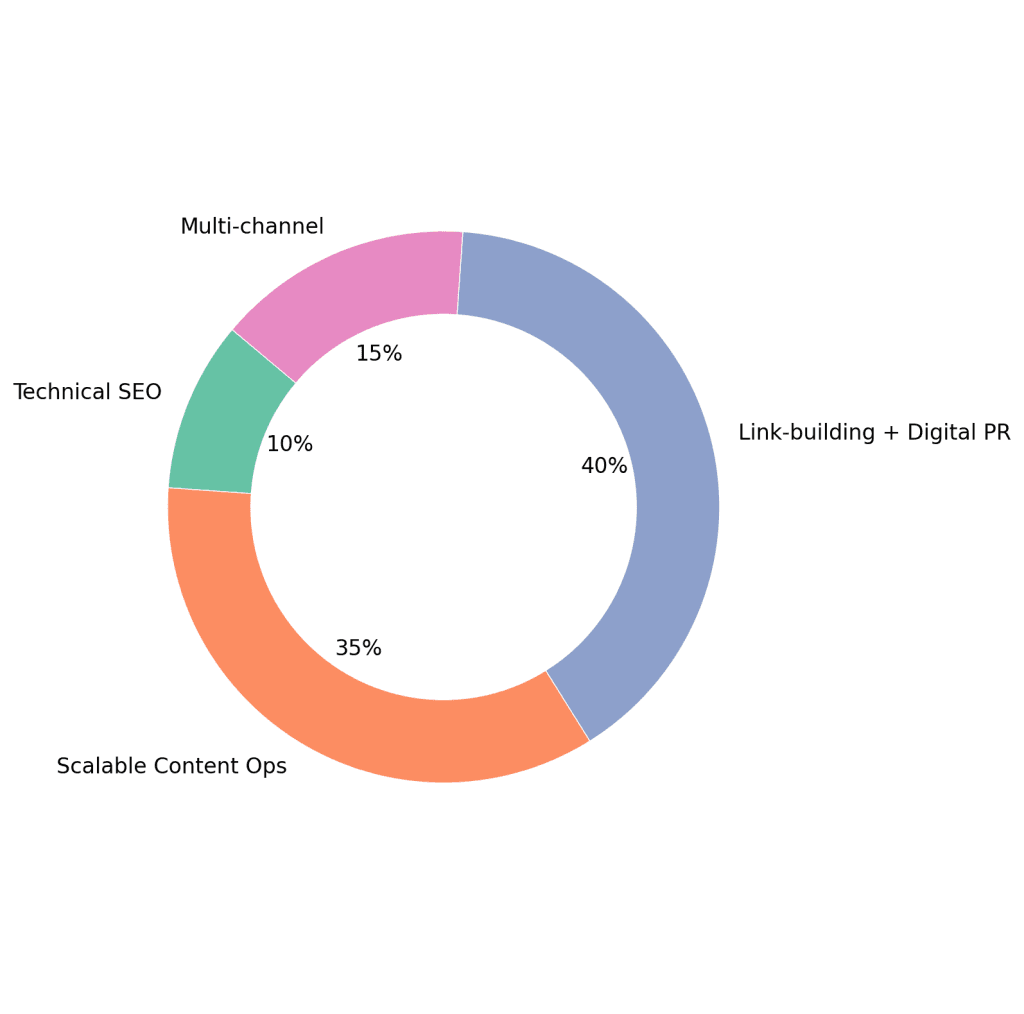
For early-stage companies with a limited marketing budget, reallocating even $3–5K/month from paid to SEO enables:
- Strategic content velocity (4–6 pieces/month)
- Technical SEO ops coverage (site health, indexation, schema)
- Early link-building and brand mention initiatives
Interpretation: SEO is not cheaper, it’s more scalable
SEO is not free, and its payoff isn’t instant. But unlike paid, it builds owned equity in discoverability. Every click earned is no longer bid-dependent. Every backlink earned is not rented, it’s a permanent signal.
Recommendation for early-stage teams:
- Use paid to test ICP messaging and funnel velocity
- Deploy SEO when you’ve validated PMF and need scalable, margin-friendly growth
- Align spend not by attribution model, but by cost per opportunity over time
CAC sustainability is not channel-blind
If you spend $8,000/month on ads and close deals at $500 CAC, you must maintain spend to sustain flow. If you spend $2,000/month on SEO for six months and build assets that rank and convert, you reduce CAC over time and improve margin resilience.
SEO becomes a CAC hedge when:
- Product-market fit is clear
- Activation queries are mapped
- You’re optimizing content for decision journeys, not just impressions
This is where a structured SEO growth strategy for early stage companies differentiates from ad-first models: it compounds under fixed budget ceilings rather than scaling linearly with cost.
Startup SEO checklist for the first 90 days
The first 90 days are not about publishing volume. They’re about building a crawlable, evaluative, intent-mapped system that compounds. Below is a zero-fluff checklist designed for startup operating constraints: lean team, low authority, and short CAC feedback loops.
Don’t execute all at once. Sequence by impact on indexability, intent mapping, and conversion alignment.
Week 1–3: Technical foundation audit and cleanup
☐ Set canonical domain and HTTPS redirect (non-www vs www)
☐ Remove index bloat: block staging, unused subfolders, and expired pages
☐ Fix 404s, orphan pages, and broken internal links using crawl tools
☐ Validate structured data (FAQ, HowTo, Product, Breadcrumbs) for all key pages
☐ Submit XML sitemap after crawl prioritization (not just auto-generated)
☐ Verify mobile-first rendering with real device testing, not just Googlebot preview
☐ Set up log-level crawling behavior tracking to monitor discoverability bottlenecks
Week 4–6: Intent mapping and semantic architecture
☐ Map top 3 conversion intents (e.g., “best [X] for Y use case,” “tool vs tool,” “how to migrate from [X]”)
☐ Build 2–3 foundational content clusters around product-fit search demand
☐ Design content architecture: pillar, spoke, comparison, and programmatic pages
☐ Use GSC “Queries” and competitor Gaps to validate alignment
☐ Create query-to-page matching map (each page must target a distinct evaluator query, not overlap with siblings)
Week 7–9: Content launch and signal generation
☐ Publish minimum viable cluster (3–5 articles) linked internally with clean anchor logic
☐ Add supporting trust signals: customer use cases, testimonials, integration mentions
☐ Submit URLs for indexing only after all schema and links are in place
☐ Build first 10–15 high-signal backlinks via:
- Community mentions
- Founder guest posts
- Product documentation
- External changelogs or API directories
☐ Set up performance monitoring with crawl frequency, rank flux, query CTR, not just traffic
Ongoing: Ops hygiene and refinement loop
☐ Run bi-weekly crawl diff to catch regressions (redirect chains, JS bloat, coverage drops)
☐ Update internal links monthly based on click path analysis, not arbitrary hierarchy
☐ Refresh content that hasn’t triggered impressions within 6 weeks
☐ Rebalance crawl budget monthly—prioritize top 10 URLs based on intent value, not just volume
This checklist isn’t tactical. It’s architectural. SEO systems scale when foundation, semantics, and signals align, especially under startup constraints.
SEO is a startup growth system not just a channel
SEO is not a visibility tactic. It is a scalable system that strengthens product discovery, reduces CAC, and compounds over time. For startups with a finite budget and narrow focus, it functions as operating infrastructure not auxiliary marketing.
Unlike paid acquisition, which resets with each budget cycle, organic search builds durable discoverability. High-intent content, strategic linking, and structured architecture create assets that earn relevance without recurring spend.
Where most startups fall short is in execution, not effort. Publishing volume without search intent mapping, launching pages without crawl readiness, or measuring success via traffic instead of conversions dilutes impact.
SEO done right doesn’t just bring users. It brings users in evaluation mode, aligned with solution-state queries. That precision reduces acquisition cost, shortens decision timelines, and increases user retention.
When integrated early and structured for intent, SEO becomes a growth lever that improves efficiency across the funnel, long after content is published.