Let’s say you’re trying to kill some time and you’re scrolling through social media.
Where do you click? Is it the giant block of text or a shiny little video thumbnail? Exactly.
Videos are everyone’s favorite, and search engines are serving them up like free samples at Costco.
The problem is that videos are a lot of work. You need to film the content, then edit it (or beg one of your techy friends to do it for you), spend way too much money on software you’ll never really understand, and then?
Keep your fingers crossed, it’ll do well because it would be tragic if you spent all this time and money only for it to flop. If only you had a magic wand that could serve up videos on a platter.
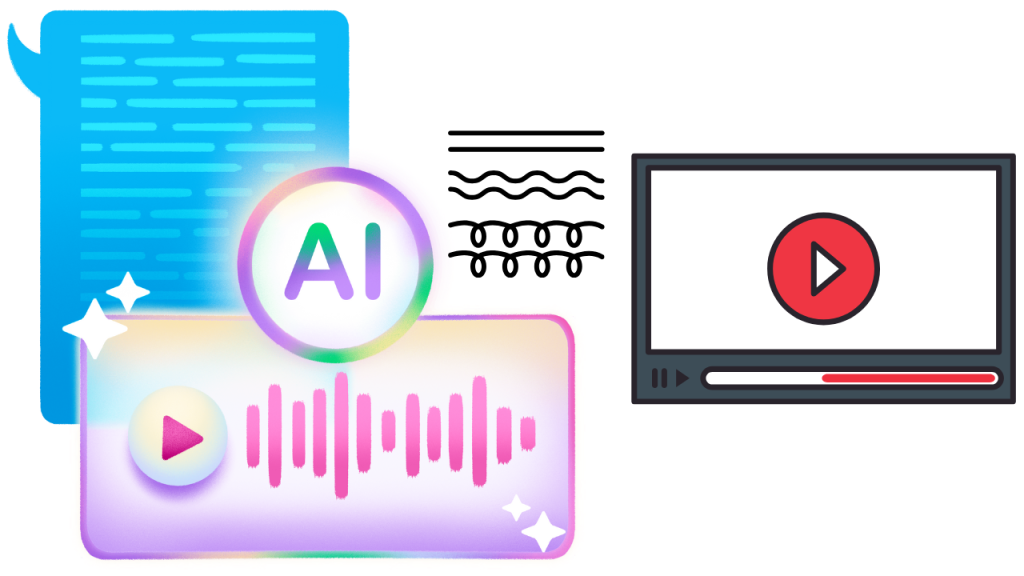
We still don’t have anything magic to work with, but AI is close to it. It can turn plain text into polished videos faster than you can turn your ring light on.
Cool shortcut, right? But it’s more than that; this is a serious SEO move. Google loves video, and audiences love video. Read on, and you’ll see why using an AI video maker from script tool will pay off.
Why video is becoming more and more important for SEO

If search engines had a cafeteria, videos would be sitting at the cool kids’ table.
Google has practically rolled out the red carpet for video content with featured snippets, carousels, video boxes, and all that stuff that takes up space at the very top of search results. And let’s not forget Google’s younger brother, YouTube, which is the second biggest search engine in the world.
Still not convinced?
Let’s take a look at some data points:
| 82% of businesses use video marketing, with 93% of them reporting positive ROI. – HubSpot Pages that have video are 53x more likely to rank on Google’s first page. – Search Atlas 157% more organic traffic for results with video. – Wyzowl Using AI, you can cut the video production time by 62% (8 days saved on average per project). – Synthesia AI video production has jumped from 18% in 2023 to 41% in 2024; that number is expected to grow. – Siege Media |
For you, this means that ignoring videos is a huge no-no. Luckily, script to video maker AI tools make it ridiculously easy for businesses of all sizes to jump on the bandwagon and create videos that’ll get them noticed. And that means by both audiences and algorithms.
The numbers back this up.
Reports keep showing that people watch billions (yep, that’s the big B right there) of hours of videos on YouTube every single day.
TikTok and Shorts get so much engagement, it’s unreal because people are far more likely to share and comment on videos than on posts that are just plain text. From a marketing and SEO perspective, video content is the golden ticket towards putting yourself on the map.
Search engines absolutely love videos because they keep people on a page longer. There are two websites, and both are competing for the same keyword.
One has a bunch of text that, although it explains it all well, feels more like doing homework than anything else.
The other page describes the same thing in under two minutes with a video. Which one keeps the visitors from clicking away? That extra time on page is what SEO experts call dwell time, and, as far as search engines go, it’s gold dust. Add to that the fact that video reduces bounce rates, and it even improves click-through rates because of thumbnails.
All of a sudden, your boring blog post becomes something people stick around for and search engines want to rank higher.
But back in the day (meaning, before automated video creation and AI), you didn’t see that many videos because making them was a whole ordeal. You needed expensive equipment, editing software that was anything but easy to use, possibly paid actors, and hours (if not days) of work.
If you didn’t have a sizable budget, forget it; you were stuck with text.
Now, however, things have changed because AI tools make it possible to turn text into polished, voice-narrated videos.
And you don’t need to hire a crew or spend weeks on editing the thing, it’s all done for you. A few clicks is all it takes to produce content that looks like it cost a fortune, but it didn’t.
That’s the real magic – no more friction.
The barrier to entry is nowhere to be seen, and a small entrepreneur that has nothing more than a laptop and ambition can produce a video just like a big brand with a whole team behind them can.
And since the tools are built around automation, they’re made to be easy in all aspects, so you can keep making videos without their quality going down. Traditional videos were like seven-course meals. You needed a lot of ingredients, time, patience, and skill to make it happen, not to mention the chunk of money to finance it all.
AI videos? Well, you’re still getting the five-star results, but you’re ordering takeout from a Michelin-star chef instead of burning your kitchen down.
What happens behind the scenes
You’re probably curious about the digital wizardry that happens behind the scenes to make these AI videos possible.

The answer is, it’s a mix of seriously clever tech. The tools rely on natural language processing, which is how they can understand your script the way a human would. Without NLP, words would look like random squiggles on a page, but with it, AI can break down the meaning and the tone so it knows what you want.
A serious presentation or a fun tutorial that makes learning and laughing go hand in hand?
AI can understand all of it.
Then there’s text-to-speech, which is how AI adds a voice.
You might be worried that this will sound like a GPS from 2008, but that isn’t the case. The voices are customizable and natural. In some cases, they’re so real they’re borderline creepy.
Once the words are handled, the baton passes to machine learning and computer vision to match your script with the right visuals and animations.
So, you start with a script, the AI turns it into voice, images, and scenes, and then it pulls it all together in AI video editing. In the end, the rendering engine spits out a video file that’s ready for the world.
The whole thing was done within minutes, and all you needed for it was a laptop.
The true beauty is in automation. Of course, there’s still a place for manual editing, and that’ll stay the same for the foreseeable future, but the efficiency of AI?
| 87% of marketers said video marketing boosted sales. – HubSpot |
You can scale in ways you didn’t even dare to think about before. Five explainer videos, two tutorials, and a promotional ad by tomorrow? Easy-peasy.
But tell this to a traditional editing team and they’ll either laugh or cry. Possibly both. Well, probably both.
AI, on the other hand, gets to work.
These platforms are built to handle the most common video types businesses use, like explainers, product demos, tutorials, and ads. Different tools might specialize in different formats, but the idea is the same every time: turn text into video fast, without putting a damper on your time, budget, space, and sanity.
So, what happens behind the scenes isn’t magic, it’s really, really smart tech.
You focus on the big picture, and the automation handles the boring stuff. And the best part? You don’t need to learn what half the buttons in Adobe Premiere do.
Actually, does anyone know that? Never mind, now we don’t have to.
5 types of AI videos that work best for SEO
SEO doesn’t treat all videos the same, so let’s see which ones are worth the effort.
1. Educational and How-To Videos
You know how cats react to catnip? That’s exactly how search engines respond to educational and how-to videos.
The reason is simple – they answer questions directly, which is exactly what users type into Google every single day.
Say someone types in “How to make a sourdough starter?” and you have a video with clear, step-by-step instructions.
A wall of text will never be as valuable as that.
These videos pull in long-tail keywords, which may not get millions of searches, but they’re easier to rank and bring in people who already have an interest in a particular topic.
That’s SEO gold, and it’s exactly the kind of content an AI video generator can help you scale.
2. Product Demonstrations
Product demo videos are extremely important because they’re like the online equivalent of someone test-driving a car before buying it. In other words, they show how your product works in action and what features it has.
This is a big deal for the customer because they’re able to picture themselves using it.
From an SEO standpoint, these videos do wonders for conversions because they answer those big questions every customer has, like Does this actually work or not. The moment you have visual proof to provide, there’s less doubt, and people are more likely to click that ‘Buy now’ button.
An AI explainer video maker can make this easy on you, since it can automate demos for more than one product.
3. Brand Storytelling
These videos don’t just try to sell the product; they aim to sell an identity.
They’re powerful because people remember them. The focus is not on features or instructions but on connection. It could be a BTS video that shows your company culture or a mini-documentary about why your brand exists.
Looking from the SEO perspective, brand storytelling videos help with brand recall and give you an edge in a crowded market, where everyone is screaming at the top of their lungs about how great their product is.
You can use AI video production software to tell consistent stories across all campaigns and platforms without your bank account becoming scarily empty.
4. Explainers and Tutorials
These overlap with educational content, but they focus more on breaking down something complex. They show that you know your stuff, which is important for authority and trust.
For example, if you’re a software company, a short explainer about how your tool works can wipe away confusion. If you’re a makeup artist launching a new primer, you can show which base it works best with and which tools to use for application.
Another great thing about tutorials is that they answer some very common questions from customers before they even hit your inbox.
Search engines go wild for this because it shows your content isn’t fluff but something useful and comprehensive.
5. Short-Form Content for Social SEO
TikTok clips, Instagram reels, YouTube Shorts, and short-form content in general are the rocket fuel of discoverability. It’s like snacks, everyone loves them.
They’re quick and spread fast, which means that they can bring traffic back to your main site or long-form content.
| Videos under one minute see an avg. engagement of 50%; 60+ min videos have an avg. engagement rate of 17%. – HubSpot |
They’re very powerful for SEO, and the thing that makes them that is synergy. They get you attention on social platforms and then feed that audience into your deeper content ecosystem. You can think of them like short trailers that convince people to watch the full thing.
And with today’s AI-powered video content, you can have a steady stream of short clips that keep your brand visible all the time.
The technical side of things
Okay, so your video is done. Congrats!
Now what?
You could post it and keep your fingers crossed that Google decides to sprinkle SEO fairy dust on it, but do you really want to gamble? You need to think about the technical side of all this, or you’ll be left with hopes and dreams.
Let’s start with the basics: optimization.
Titles and meta descriptions are the bread and butter of search visibility, and if you add the right keywords in the right places, your content has a much better shot at getting noticed.
Thumbnails are important, too, and they don’t get as much credit as they deserve. Nobody will click on a bland thumbnail, though, but a smart one can work like magic for your CTR. If you’re working with a tool that translates text to AI video, it might suggest a thumbnail that fits the script and tone.
| Pages that contain video have 41% higher CTR compared to text-only pages. – Backlinko |
Now, here’s the part a lot of people skip – structured data (aka Google Schema).
The term’ schema markup’ sounds intimidating, but it’s just structured information you feed to Google so it knows your video isn’t some random upload. When you have metadata and page content aligned with each other, you have a better chance of appearing in video-rich snippets. And even if you don’t know you want it, trust us, you very much do.
This is where AI video editing tools can save you a ton of time, since many of them now generate metadata or transcripts you can repurpose for schema.
Hosting and embedding is where strategy comes in.
YouTube is the obvious choice that has global reach and built-in discovery. But the downside is that all that traffic usually stays on YouTube instead of spilling over to your site. You can get full control with self-hosting, but you have to watch out for speed issues with bandwidth (neither of which is problematic with YouTube).
If you’re using a script to video software to produce lots of clips, think about a CDN to keep the pages fast.
Users hate waiting 15 seconds for videos to buffer, and Google? It hates that even more.
The thing that ties all of this together is accessibility. You want both subtitles and transcripts, and not just for users who can’t or don’t want to listen with sound. They’re also useful for search engines, so they have more text to crawl.
| 68% of surveyed marketers said that they plan on focusing on video marketing in 2025. – Wyzowl |
And if you’re thinking ahead, you can also include AI marketing videos into the mix so you can reach people on social media, too.
| Why AI video makers (Recap) AI turns scripts into videos fast and cheap. Video helps boost SEO (dwell time, CTR, rankings, etc.). Best types of videos are: how-tos, demos, explainers, and stories. Short-form video has better performance. Don’t forget to optimize video titles, metadata, schema, thumbnails, etc. |
Wrapping up
Who needs a camera and a set?
You don’t even need other people to help you create a video. And that includes the annoying one who considers themselves a ‘content guru’. It’s a well-known fact that video content will put even a baby name consultant (yes, that’s an actual job nowadays) on the map, but it used to be reserved for big brands who had the cash to pay for it.
Luckily, AI has made it possible for even the smallest of entrepreneurs to get into the race and have an actual shot at getting somewhere.