Search engine visibility isn’t the same as it was in, say, 2015. With the advent of AI overviews in SERPs, everything has changed.
Leave all shortcuts. None of those work today. If you want to increase website visibility for the long term, focus on creating high-quality content and building back links from reliable, authentic sources. Research for keywords that users are putting into the search tabs and optimize your website accordingly. Meet user intent, and you’ll be featured at the top of SERPs. In these times of quality over quantity, everything else is non-functional. What works is – Please the users, and search engines will reward you.
Users are happy with the AI Overviews that Google gives them. And companies have little clue on how to get their content featured in the AIOs. However, SEO (Search Engine Optimization) still plays a pivotal role in creating digital marketing content. Only, it has evolved to meeting user intent ON PRIORITY. Google plans to take it further, making SEARCH a pleasing and time-efficient experience for the users.
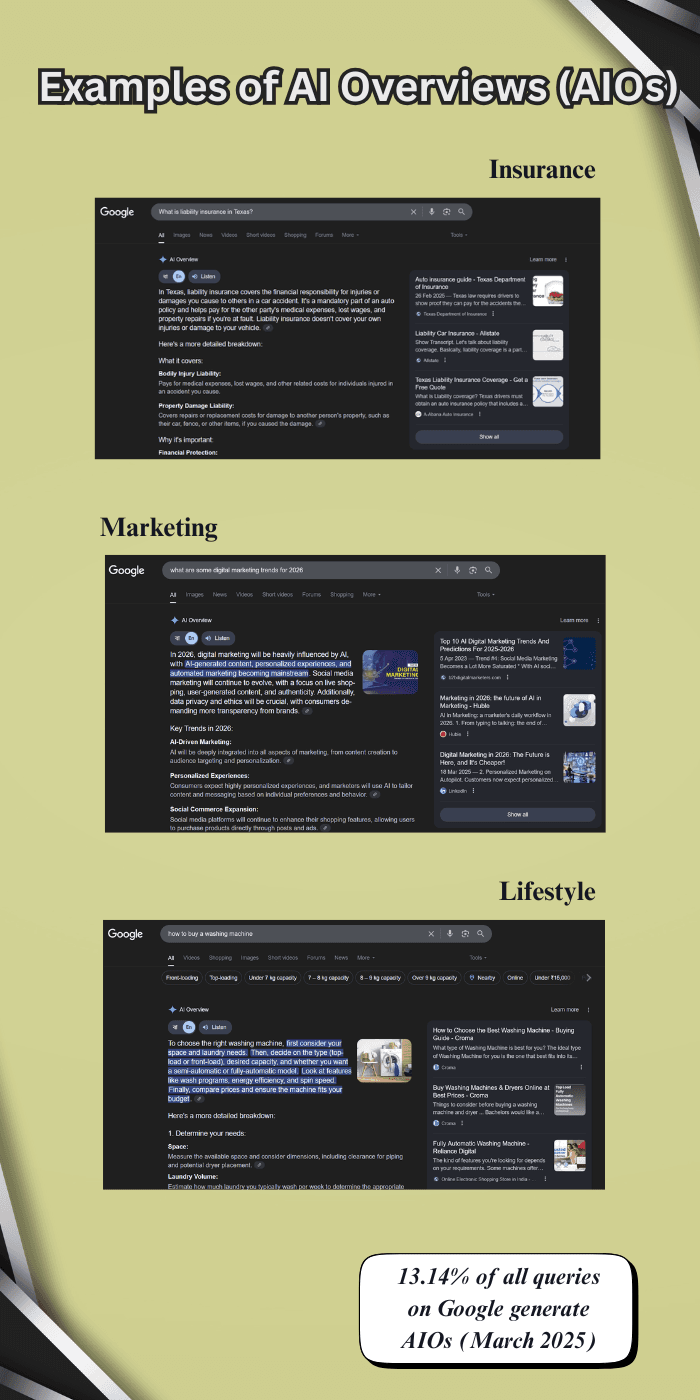
And rightfully so. Users should get the best experience, undoubtedly.
So, how to increase website search engine visibility in this AI-dominated world?
Understand The Whole Scenario – What’s Going on?
Before you jump in and start following what every digital marketing influencer is saying, it’s essential to understand the entire, revamped search landscape.
Here’s a list of a few observations for you:
- AIOs are upping – In March 2025, about 13.14% of all Google queries resulted in AI overviews. It’s a 6.6% jump from January 2025.
- A massive share of AI content is informational – Nearly 88.1% of queries that trigger an AIO response are informational (Informative bloggers are crying in the corner).
- YMYL (Your Money Your Life) topics getting more AIOs – YMYL topics that directly affects people’s well-being, like health, finances, legality, and safety, are getting more AIOs than ever – 15.18% of Legal and Government-related topics, 20.33% of healthcare, and 10.08% of finance.
- Linking to sources – In more than 92% of cases, the AIOs have been seen citing at least one source from the top 10 websites in organic rankings. While the average number of sources in AIOs is 6.82, Beauty and Lifestyle, Career, Jobs and Relationship-related topics have slightly more links.
- US SERPs feature both AIOs and Google snippets – 30.80% of US queries have been seen to trigger both AIOs and featured snippets. The suffering of organic SERPs is doubled in these cases.
- Long-tail keywords triggering more AIOs – In over 60% of cases, keywords with more than 4 words trigger AI responses on Google. Interestingly, keywords with low search volumes are also generating AIOs most of the time.
A quick question – How much space are the AIOs taking up in the SERPs?
A: Almost 50% of both your desktop and mobile screens. If accompanied by featured snippets, 76% of screen space is gone! Poof!
So this is the current scenario in a nutshell. If you have the guts to try and increase website visibility even in this situation, kudos! You’ve just reached the right place.
What is Search Engine Visibility?
A few years ago –
Search engine visibility refers to how prominently your website appears in the search engine results page for relevant keywords. It determines whether users can easily discover your content when searching for specific terms related to your industry or offerings. Higher visibility means greater exposure, leading to more organic traffic, brand recognition, and potential conversions.
Fast-track to today –
Search engine visibility is about taking your website content to the top 10 list of organic SERPs. As Google cites at least one domain from the top-tens, you have a higher chance of getting your content included in the AIOs and featured snippets. Once your content gets featured in the AIO, website traffic will increase manifold.
Google covers about 89.73% of user queries, while Bing has a market share of 3.98% currently. Together, they have covered 94% of all internet search queries. If you can crack Google’s code to reach the top, Bing’s search visibility will improve automatically.
Search Engine Visibility Calculator
Enter your keywords, monthly search volume, and current ranking position. Then click Calculate Visibility to see your estimated organic traffic.
| Keyword | Monthly Search Volume | Current Ranking Position | Action |
|---|---|---|---|
How to Boost Search Engine Visibility by 2X
It’s an age of revamping your digital marketing strategies. Think ‘User Intent’ and E.E.A.T. to improve search engine visibility.
As Google is hell bent to “do the searching” for the users, we can also upgrade our content marketing strategies, keeping user intent on a priority. In other words, let’s please the users to please the search engines.
Now, how to do that and where to start?
The Basics – Some things are universal
Some of the timeless strategies to increase search engine visibility are effective even today. If you get them right, you walk one step ahead of your competitors in getting to the top 10 in SERPs.
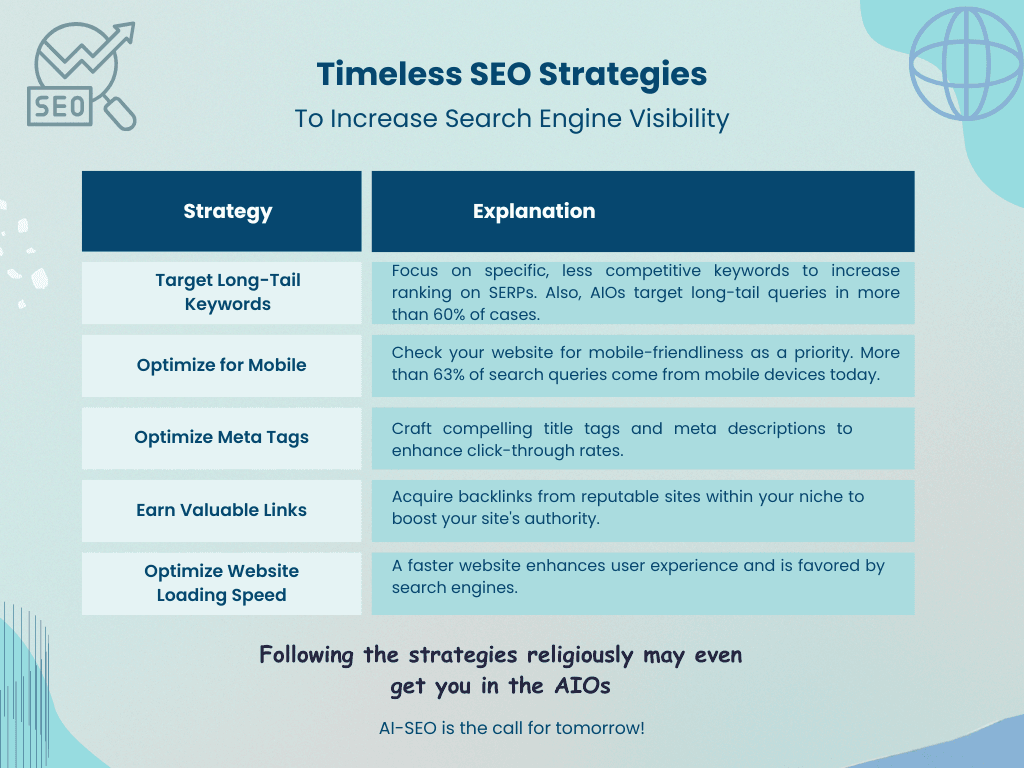
Advanced Strategies to Increase Search Engine Visibility
Most of the advanced strategies to increasing website search visibility today are based on how you create and publish your content.
Yes! That’s right. Content is dominating the search landscape like before. Only it has changed to cater to the evolved preferences of search engines.
The basic aim of every website owner is to drive organic traffic and achieve business growth. By implementing the techniques below, you can significantly make your website more visible in an AI-dominated search landscape.
Fulfilling User Intent with Relevant Content
It’s simple. Use Analytics tools (like SEMRush, Ahrefs, Moz, etc.), to analyze user search queries, check competitor content, and fulfill those queries by creating relevant and informative content.
Actually, NOT that simple!
You need to create content that identifies and addresses issues that your target audience is facing. The more direct the narrative, the easier it will be for users to get their issues resolved. And Google will definitely bring your content to the top to answer user queries.
The 6-step strategy to fulfilling user intent:
- Understand user intent – Know what your users are looking for. Do they need information or query resolution? Wait! They might be looking for more information on a product to BUY it. Are they looking for directions to a place? Understand and approach accordingly.
- No jargon or flowery language – Be clear and precise. Value the users’ time.
- Break long texts into bullets, charts, graphics – Whatever makes your content more entertaining
- Be specific – Generic content fails to address the problem head-on, resulting in confusion
- Proper structure and formatting – Navigating through long-form content should be a cakewalk for the users
- Include CTA (Call-to-Action) buttons – Spread these evenly across the content body to help users understand what to do next
If you’re successful in fulfilling user intent, the chances of increasing website visibility will get higher, come what may!
Improving The E.E.A.T Factor
Although AI-based responses are dominating the SERPs, Google did its part to ensure that they don’t replace high-quality human writing. In its August 2023 core update, it did mention that websites with high EEAT content will see a significant increase in search visibility.
Now what’s this E.E.A.T factor?
E.E.A.T stands for Experience, Expertise, Authoritativeness, and Trustworthiness. If your content has these four essential qualities, it has a higher chance of getting featured at the top of SERPs.
How to improve the E.E.A.T factor?
- Experience – Do you have hands-on experience in the topic you’re writing on? If no, you can take the help of others’ examples, cite resources, case studies, etc., to make it authentic and believable.
- Expertise – Are you confident about the topic you’re writing? You can become one by using data, reports, and facts in your content.
- Authoritativeness – The content should be backed by industry knowledge and the overall reputation of your business in the industry. For example, if you sell shoes and you write travelogues, it won’t work.
- Trustworthiness – Can the users rely on you for information on a particular topic? Establishing trust is crucial to improving the E.E.A.T. factor.
Creating Informative Topic Clusters
Creating a cluster of content linked to a pillar page on a relevant topic helps achieve topical authority – a verified way to reach E.E.A.T. goals.
Organizing content into topic clusters involves creating a central ‘pillar’ page that provides comprehensive coverage of a broad subject, supported by interlinked subtopics.
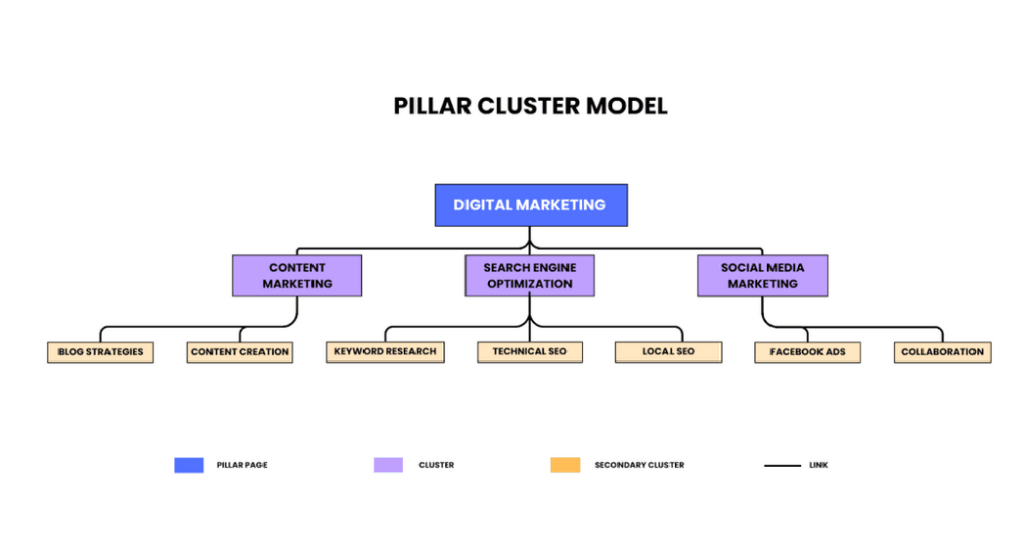
This structure signals to search engines that your website offers in-depth information, enhancing its authority and improving SEO performance.
Implementation Steps:
- Identify Core Topics: Determine broad subjects relevant to your audience and business.
- Create Pillar Pages: Develop comprehensive content that covers each core topic extensively.
- Develop Cluster Content: Produce detailed articles focusing on specific aspects of the core topic.
- Interlink Content: Link cluster pages to their respective pillar page and vice versa to establish a cohesive content network.
Schema Markup Implementation
Schema markup, or structured data, helps search engines interpret contexts of each content, leading to enhanced search result displays, like rich snippets. As we know, featured snippets provide users with immediate, relevant information. Listing your content in a snippet improves your chances to increase search engine visibility, as well as website click-through rates (CTRs)
The 4-fold path to applying Schema Markup:
- Understand Schema Types: Familiarize yourself with various schema types relevant to your content, such as articles, products, or events.
- Implement Structured Data: Use schema markup to annotate your content, providing clear context to search engines.
- Validate Markup: Utilize tools like Google’s Rich Results Test to ensure correct implementation.
- Monitor Performance: Check search appearance reports to assess the impact on visibility and click-through rates.
Voice Search Optimization
The increasing use of voice-activated assistants has made voice search a significant factor in SEO. Nearly 20.5% of users search through voice today. And this share will expand in the coming days. There’s no doubt that optimizing your content for voice search is crucial to ranking it higher. You may need to focus on natural language queries and providing concise, accurate answers to common questions.
Here are some voice optimization hacks to help:
- Use Conversational Keywords: Incorporate long-tail keywords (over 5 words) that reflect natural speech patterns.
- Answer Common Questions: Create content that directly addresses frequently asked questions in your industry.
- Implement Structured Data: Apply schema markup to help search engines identify concise answers suitable for voice queries.
- Enhance Local SEO: Optimize for local searches by maintaining accurate business listings and including location-specific keywords.
Video Marketing Strategies
Every one of us is aware of the dominance of short-form video content today. Nothing’s hidden from the common eye. But long-form, explainer brand videos are not much behind.
- 84% of users accepted making buying decisions after seeing a brand’s video.
- More than 90% of businesses are using video marketing to increase website visibility and enhance brand recognition.
- About 1/3rd of the world is active on YouTube (2.49 billion).
- AIOs favor globally-recognized domains, like YouTube, etc. for their featured content
Do you now realize why optimizing your content for video search is an effective tool to increase search engine visibility?
How to optimize video marketing the right way:
- Craft Descriptive Titles: Use clear, keyword-rich titles that accurately reflect the video’s content.
- Write Detailed Descriptions: Provide comprehensive descriptions with relevant keywords to improve search visibility.
- Include Transcriptions: Offer text transcripts of your videos to make content accessible and index-able by search engines.
- Utilize Video Schema Markup: Implement structured data to provide search engines with detailed information about your videos.
Getting Featured in Google’s AIOs
Well, it may be the last one. But it’s necessarily the MOST IMPORTANT of all. All the aforementioned strategies blend in to overcome this one challenge – How to get included in Google AIOs and Featured Snippets.
A brief understanding of Google’s AIOs
Google’s Search Generative Experience (SGE) introduces AI-generated snippets, known as AI Overviews (or AIOs), that provide on-point answers directly WITHIN the search results. As the AIOs appear above organic listings, users get their information directly without scrolling down to third-party sites.
The results?
- Your content suffers
- Your website search visibility suffers
- Low traffic influx
- Low conversions
- Everything low!
However, a reevaluation of key SEO principles can ensure your content remains visible and engaging.
Strategies to Enhance Visibility in AI-Driven Search
- Concise and Informative Content: Craft content that directly answers common user queries. It increases the chances of getting featured in AI Overviews. Focus on clarity and relevance to align with AI-based algorithms.
- Schema Markup: Implement structured data to provide search engines with explicit information about your content’s context and structure. This aids AI in accurately interpreting and featuring your content in its overviews.
- Build Credible Content: Develop content that showcases your expertise and authority in your field (read E.E.A.T.). AI systems prioritize information from reputable sources, so establishing trustworthiness is essential for visibility.
Challenges and Practices
Adaptation Strategies: With AI providing direct answers, websites are experiencing a decline in organic CTRs. You may counter this by focusing on in-depth content development. It’ll encourage users to seek more beyond the AIOs.
Advocate for Proper Credit: Ensure that AIOs attribute your content appropriately, including links back to your site. It will increase website visibility and drive referral traffic, even when users obtain quick answers from the AI overviews.
Using Emerging Technologies for Improved Visibility
Gather as much information as possible on the current and emerging trends in the AI-powered digital landscape. When asking the question of how to increase website search engine visibility, your knowledge will help. Let’s explain:
Artificial Intelligence and Machine Learning
AI and ML have revolutionized organic search visibility by enabling search engines to better understand user intent and deliver more relevant results. Algorithms like Google’s RankBrain utilize machine learning to process and interpret complex search queries, influencing search rankings based on user behavior and engagement metrics.
Practical Applications:
- Keyword Analysis: AI-powered tools can analyze vast datasets to identify high-performing keywords, uncovering patterns, trends, and intent for more effective SEO campaign management.
- Content Optimization: Machine learning algorithms assess content relevance and structure. They provide valuable insights into readability, engagement, and user intent.
Multimodal Search Capabilities
Multimodal Search integrates a wide range of input – text, images, and voice – allowing users to conduct searches using multiple modalities simultaneously. As the approach reflects natural communication patterns, it enhances the organic search visibility by accommodating diverse user preferences.
Optimization Approaches:
Adaptable Content: Ensure your content is versatile and accessible across different formats. Optimizing images with relevant alt text, providing transcripts for videos, and structuring website content to appease voice search technologies.
Measuring and Analyzing Search Engine Visibility
Effectively measuring and analyzing search engine visibility is crucial for assessing the success of your SEO efforts and identifying areas for improvement. This process involves utilizing essential tools and monitoring key performance indicators (KPIs) to gain comprehensive insights into your website’s performance.
Essential Tools
- Google Search Console: This free tool from Google allows you to monitor your website’s search performance, identify indexing issues, and understand how your site appears in search results. It provides data on search queries, click-through rates (CTR), and site errors, enabling you to optimize your site’s visibility.
- Third-Party SEO Tools: Platforms like Semrush and Ahrefs offer in-depth analysis of your website’s SEO health. They provide features such as keyword tracking, backlink analysis, site audits, and competitive research, which are essential for developing effective SEO strategies.
Key Performance Indicators (KPIs)
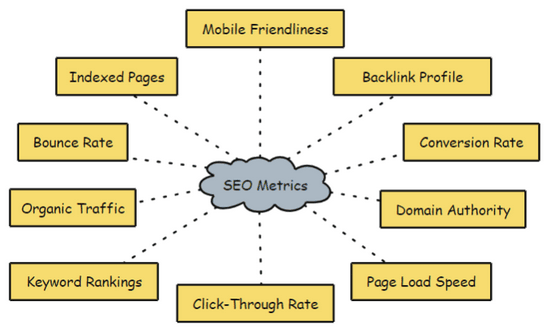
- Organic Traffic: It measures the number of visitors arriving at your website through unpaid search results. An increase in organic traffic indicates improved search engine visibility and effective SEO practices.
- Keyword Rankings: Monitoring the positions of your targeted keywords on SERPs helps assess the effectiveness of your SEO efforts.
- User Engagement Metrics: Analyzing metrics such as bounce rate, dwell time, and pages per session provides insights into how users interact with your website. High engagement levels depict valuable content, and a positive user experience, which increases search engine rankings.
Regularly monitoring these tools and KPIs helps you:
- Make data-driven decisions,
- Refine your SEO strategies, and
- Enhance your website’s search engine visibility.
By focusing on these metrics, you can identify successful tactics and areas needing improvement, ultimately boosting your online presence.
Ethical SEO Practices for Sustainable Visibility
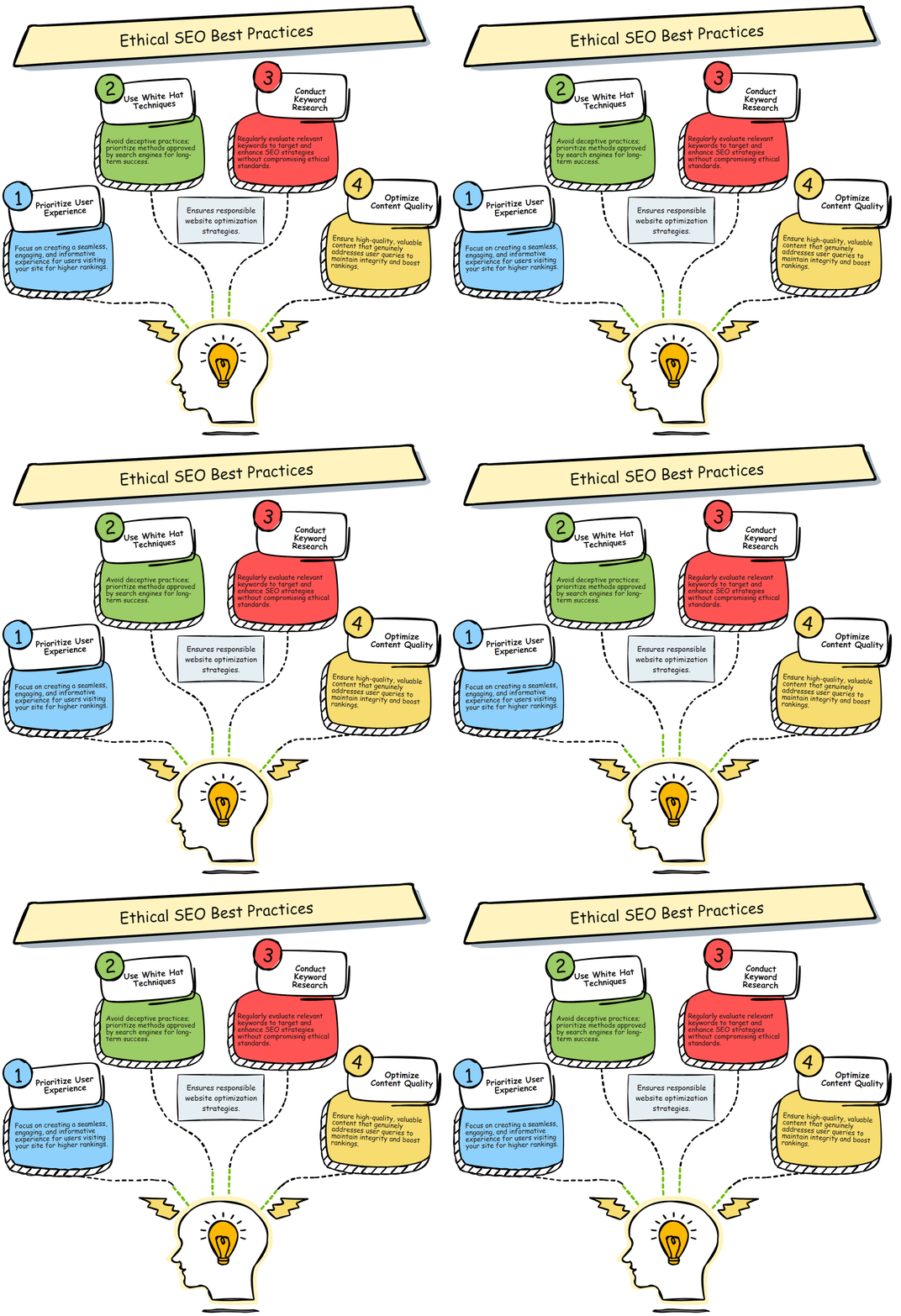
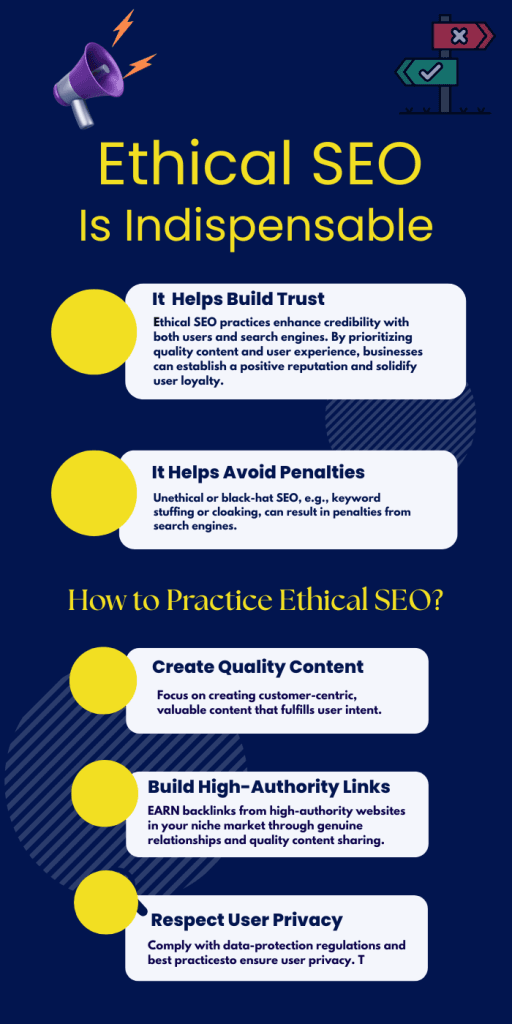
Ethical SEO practices primarily focus on strategies that evoke TRUST.
Stuffing your content with keywords to get higher ranks, buying backlinks to your website, and cloaking the information are some of the unethical practices that you should avoid. Search engines take these very seriously and may even penalize your site for the same.
So, how does ethical SEO help increase your website’s search engine visibility?
Future Trends in Search Engine Visibility
The search landscape is still evolving. AIOs are not the end and will never be. Search engines, like Google, Bing, and Yahoo, are on a roll to enhancing search experiences for the users. And they are not slowing down any time soon.
The key is to be aware of the emerging trends and stay prepared. That is if you want to maintain or increase website visibility in these challenging times. Coming back to the upcoming trends:
Increased links to citations in the AIOs
To give smaller websites a chance to get featured, Google is increasing the number of citations in the AIOs. It has also included links INSIDE its overviews to help users find more relevant information on the topic. This is a great chance to drive traffic to your website. Even if your site is not-so-popular in your field, it can get cited in the AIOs with in-depth, authentic, and relevant content.
Isn’t that just awesome? Well, Google is amazing!
Combating LLM dominance
In October 2024, Google’s market share fell below 90% for the first time in almost a decade. The reason? It’s because more users flocked to LLMs (Large-Language-Models) to resolve their queries and seek information.
LLMs, like ChatGPT, Perplexity, Claude, etc., use a natural, conversational tone to answer queries. Most users are drawn to this approach and drop Google search altogether. Also, the LLMs have multitasking abilities that please many users. But Google is Google. Supposedly, it’ll come up with a more drastic approach to combat LLMs. Be prepared for the same.
Conversion-first SEO
Another emerging trend in the search landscape is putting conversion at the top of priorities. Most marketers are now driving in a race to ‘be visible’, but not ‘to sell’. While the former is only a way to increase selling chances, the latter is the ultimate business goal. If your content doesn’t convert (or at least open the channels for conversion), it’s going to add to the useless content traffic that search engines are tackling right now.
According to Andrew Holland, the director of SEO at a digital PR agency in the UK, “In search, traffic is vanity. Profit is sanity.”
As more content gets filtered by search engines in the coming months, businesses will realize their off-track approaches. It’s not a race to only be visible, but an attempt to CONVERT.
Finally…
Now that you’ve reached this far, let’s put it all in a nutshell for you:
- Try to increase website visibility through content (also keep your website optimized)
- Understand what the users are looking for (research keywords and competitors’ strategies)
- Don’t get overwhelmed by AIOs (It’s an opportunity. Google knows how to keep both business owners and end users happy. Trust the search experience)
- Create content keeping users in mind (search engine visibility will follow suit)
- Focus on content that sells (more subscriptions, sign-ups, or buys)
Lastly, remember, the key is not to crack the ‘magic’ code to get featured at the top of SERPs. There’s no ‘magic’ code to be honest. Just satisfy the users and help them get answers to their queries. That’s the only strategy that works today! Everything else is an illusion.